Phone:
(413) 214-6541
Location:
15 Agawam Ave West Springfield, MA 01089
Mon - Fri:
8.00am - 7.00pm
Parent Website:
sterlinganalytical.com

Jet Fuel Testing
Diesel Fuel Lab provides jet fuel testing for Jet-A, Jet-A1, and other aviation turbine fuels against ASTM D1655 specification requirements — the standard that defines minimum quality requirements for aviation turbine fuel from production to the aircraft. Our testing is conducted through Sterling Analytical, delivering ASTM-certified laboratory analysis for fixed-base operators (FBOs), fuel distributors, fuel terminals, airports, and aircraft operators who need documented fuel quality data for incoming fuel verification, contamination investigation, or quality assurance records.
Aviation fuel testing occupies a different risk tier than any other petroleum fuel testing service we offer. The consequence of fuel quality failure in an aircraft fuel system is categorically different from the consequence of fuel quality failure in a diesel generator or a commercial truck: the margin between an undetected contamination event in aviation fuel and a catastrophic outcome is far narrower, and the regulatory and liability stakes reflect that. This is why jet fuel testing exists at multiple checkpoints through the fuel supply chain — production, terminal release, receiving at FBOs, and pre-fueling verification — rather than as an annual compliance exercise.
ASTM D1655: The Standard That Governs Jet Fuel Quality
ASTM D1655, Standard Specification for Aviation Turbine Fuels, is the governing quality standard for commercial jet fuel in the United States and, through adoption and harmonization with DEF STAN 91-091 and IATA guidance, effectively worldwide for Jet-A and Jet-A1. First published in 1959 following the rapid commercial aviation expansion after World War II, D1655 defines the minimum property requirements that Jet-A and Jet-A1 must satisfy for both civil and military aircraft operations.
The fuel that destroyed that injector — contaminated with water, harboring a growing microbial colony, carrying particulate that scored the precision-machined injector tip across thousands of duty cycles — never appears in the maintenance report. There’s no line item for “fuel quality event.” There’s no way for the fleet manager looking at a year of maintenance spending to see that three injector failures and two filter change intervals last summer were all caused by the same contaminated bulk fuel tank.
An important limitation built into ASTM D1655 is worth understanding upfront: the standard itself explicitly states that it does not define the quality assurance testing and procedures necessary to ensure that fuel in the distribution system continues to comply with the specification after batch certification. This is not a gap in the standard — it’s a deliberate acknowledgment that distribution chain quality assurance requires a separate, layered testing approach. The implication is that a production-stage D1655 batch certification tells you the fuel was in spec when it left the terminal. It does not tell you what happened to it in a pipeline, truck, storage tank, or hydrant system between there and the aircraft.
This is exactly where FBO incoming testing, terminal receiving verification, and periodic quality assurance testing close the gap that D1655 batch certification cannot.
Jet-A vs. Jet-A1: The Distinction That Matters for Testing
Both Jet-A and Jet-A1 are kerosene-range hydrocarbon fuels covering roughly C8 to C16 carbon chain lengths, both with flash points above 38°C, and both specified under ASTM D1655. The primary difference that’s operationally relevant:
Freeze point:
- Jet-A: maximum −40°C freeze point
- Jet-A1: maximum −47°C freeze point
The lower freeze point requirement for Jet-A1 reflects its design for long-range and polar route operations where fuel sitting in wing tanks at high altitude for extended periods must remain pumpable at temperatures that would gel Jet-A. Most aircraft operated internationally are certified for Jet-A1; most domestic U.S. operations use Jet-A. The same ASTM D1655 specification covers both grades, with different limits applying to each grade for freeze point and certain other properties.
For testing purposes, this means laboratory results should be interpreted against the correct grade limits for the specific fuel being evaluated — a Jet-A freeze point result that’s acceptable for a domestic carrier may not clear the Jet-A1 limit required for a transatlantic operation on the same aircraft.
Why Aviation Fuel Fails: The Primary Contamination and Quality Concerns
Aviation fuel quality failures fall into three categories: contamination (something foreign enters the fuel), degradation (the fuel’s own chemistry changes over time), and specification deviation (the fuel was never in spec, or a handling error changed it). The consequences differ, but all three require laboratory analysis to detect reliably.
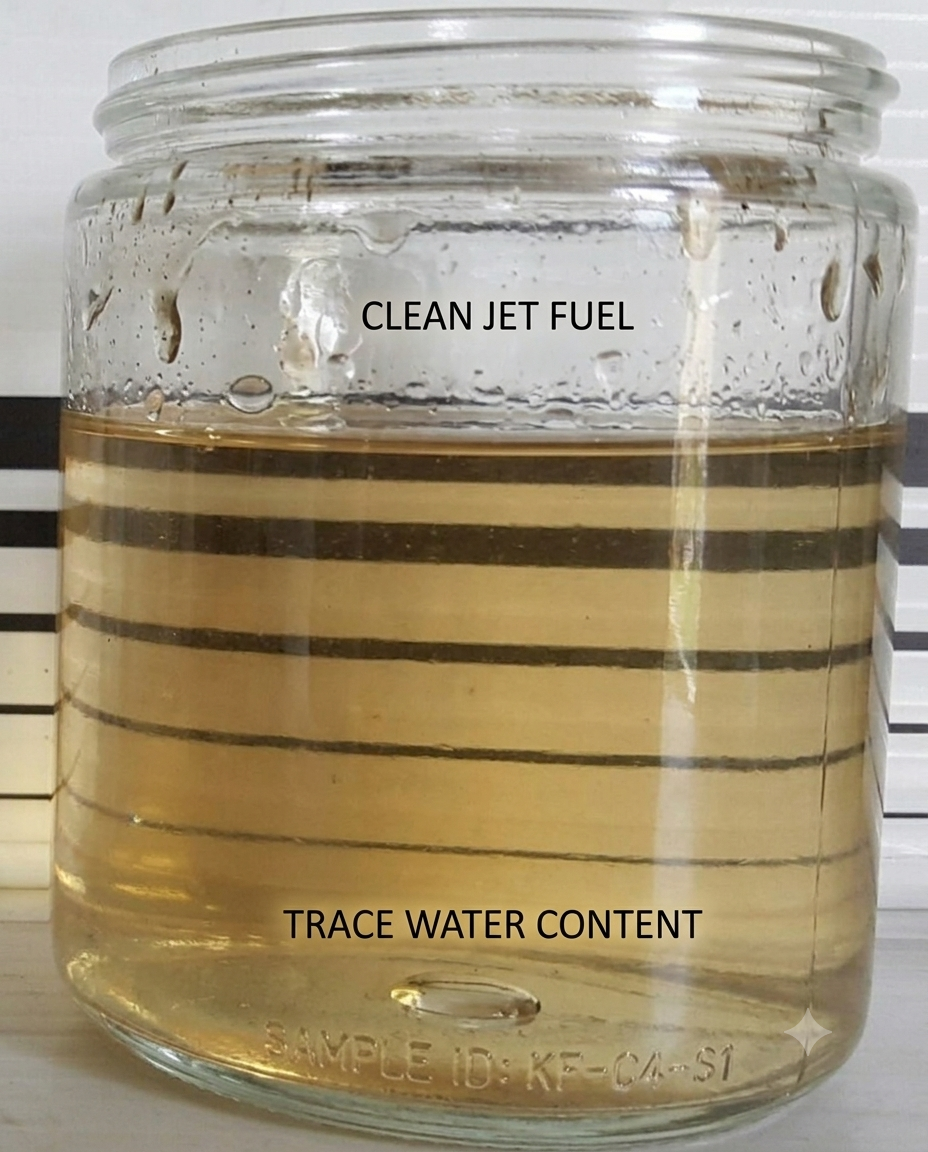
- Water Contamination Water is the most common and most dangerous contaminant in aviation fuel systems. It enters at multiple points in the distribution chain: through storage tank venting, through improperly sealed or incompletely dried equipment after cleaning, and through dissolved water coming out of solution as temperature drops. Free water in aviation fuel causes filter icing, fuel control system damage, and — at sufficient volumes — can cause fuel metering anomalies. Dissolved water at concentrations too low to form a visible separate phase can crystallize at high-altitude temperatures and block fuel system components. Both forms matter. ASTM D1655 addresses free water through water separation testing (ASTM D3948, Water Separation Index Modified) and trace dissolved water through Karl Fischer titration (ASTM D6304). The D3948 WSIM test evaluates a fuel's tendency to release entrained water — a surfactant or emulsifying contaminant can cause a fuel that appears visually clean to fail catastrophically under conditions that promote water release.
- Particulate Contamination Particulate in aviation fuel damages fuel control systems, clogs filters, and wears pump and metering components. ASTM D5452 (gravimetric filter analysis) quantifies particulate by passing fuel through a membrane filter and weighing the retained solids — a sensitive method capable of detecting contamination levels that would be invisible to visual inspection. ASTM D2276 provides a complementary line-sampling approach used in the field. The tolerance for particulate in aviation fuel is substantially lower than in diesel applications, reflecting the precision tolerances of aircraft fuel systems.
- Thermal Stability At the temperatures found in jet engine fuel systems — where fuel acts as a heat exchange medium for engine cooling before being burned — fuel that's thermally unstable forms lacquers, varnishes, and solid deposits on injectors, heat exchangers, and servo valve components. The JFTOT (Jet Fuel Thermal Oxidation Tester) test, ASTM D3241, evaluates thermal stability by flowing fuel over a heated tube at defined conditions and measuring both the color and pattern of deposits on the tube surface (tube rating) and the maximum pressure drop across a downstream filter. A tube color rating above JFTOT 3 or a pressure drop exceeding the D1655 limit constitutes a thermal stability failure — indicating the fuel will form deposits in service that can cause engine problems or, in severe cases, fuel system fires.
- Freeze Point At cruise altitudes, fuel temperatures in wing tanks can approach or exceed the fuel's freeze point, causing wax crystal formation that plugs strainers and fuel system components. ASTM D2386 (freezing point test) determines the temperature at which all wax crystals formed on cooling completely dissolve on warming — a measure of cold operability margin. Freeze point exceedances in Jet-A typically indicate a blending or refining deviation; in Jet-A1, the tighter specification allows less margin, making accurate freeze point determination critical for polar route operations.
- Flash Point A flash point below the ASTM D1655 minimum for aviation turbine fuel (38°C) indicates contamination with a more volatile hydrocarbon — most commonly gasoline or naphtha introduced through equipment cross-contamination or blending error. Low flash point is both a fire safety hazard during fueling operations and a fundamental specification failure. ASTM D93 (Pensky-Martens closed cup) is the standard flash point method for jet fuel. This is a straightforward but critically important check at every fuel receiving event.
- Electrical Conductivity Jet fuel transferred through pipes, hoses, and filters at high flow rates generates static electricity. Insufficient electrical conductivity causes that charge to accumulate rather than dissipate — a fire and explosion risk during aircraft fueling. ASTM D2624 measures electrical conductivity in the range of 50 to 600 pS/m typically required by ASTM D1655. Conductivity below specification is typically addressed by verifying the static dissipater additive (SDA) concentration is correct.
- Acidity and Mercaptan Sulfur Total acid number (ASTM D3242) measures acidic compounds that can corrode aircraft fuel system metals and elastomers. Mercaptan sulfur (ASTM D3227) quantifies a specific form of corrosive sulfur that is particularly damaging to fuel system seal materials. Both have low D1655 limits reflecting the tight materials compatibility requirements of aircraft fuel systems.
The Complete ASTM D1655 Jet Fuel Testing Panel
Parameter | ASTM Method | D1655 Limit (Jet-A) | Significance |
Flash Point | D93 | 38°C minimum | Safety & contamination detection |
Distillation (T10, T50, T90, FBP) | D86 | Multiple limits | Fuel volatility and composition |
Density / Specific Gravity | D1298, D4052 | 775–840 kg/m³ | Energy content, metering |
Freeze Point | D2386 | −40°C maximum | Cold-altitude operability |
Viscosity | D445 | 8 mm²/s max at −20°C | Cold-weather atomization |
Net Heat of Combustion | D4809, D3338 | 42.8 MJ/kg minimum | Energy delivery to engine |
Naphthalenes | D1840 | 3.0% v/v maximum | Combustion quality |
Aromatics | D1319 | 25.0% v/v maximum | Thermal stability, seal swell |
Sulfur Content | D1266, D2622, D5453 | 0.30% mass maximum | Corrosion, emissions |
Mercaptan Sulfur | D3227 | 0.003% mass maximum | Seal and elastomer compatibility |
Thermal Stability (JFTOT) | D3241 | ≤3 tube rating; ≤25 mmHg pressure drop | Engine deposit formation |
Water Separation (WSIM) | D3948 | 85 minimum (Jet-A) | Surfactant/emulsifier detection |
Existent Gum | D381 | 7 mg/100 mL maximum | Storage stability |
Particulate Contamination | D5452 | 1 mg/L maximum | Filter and fuel system protection |
Electrical Conductivity | D2624 | 50–600 pS/m | Static dissipation safety |
Acidity | D3242 | 0.015 mg KOH/g maximum | Corrosion prevention |
Additional parameters including lubricity (D5001), undissolved water (D3240), and detailed sulfur speciation may be required for specific applications, military fuel grades, or investigation purposes.
Who Needs Jet Fuel Testing
- Fixed-Base Operators (FBOs) FBOs are the critical gatekeepers between fuel supply and aircraft. Incoming fuel receiving verification — confirming that Jet-A or Jet-A1 arriving by truck or pipeline meets D1655 specification — is the primary defense against off-spec fuel reaching aircraft. The consequences of fueling an aircraft with fuel that has low flash point (gasoline contamination), excess water, or poor thermal stability are severe enough that incoming verification testing is standard operating procedure at larger FBOs and increasingly required by airline and aircraft operator quality programs.
- Fuel Distributors and Terminals Fuel distributors accepting jet fuel into terminal storage, blending tanks, or distribution equipment need batch verification testing to document that the fuel they're releasing matches the specification and the Certificate of Analysis from the refinery or pipeline origin. A failing thermal stability result at the terminal stage — before fuel is distributed to multiple FBOs — is far less costly to address than the same failure discovered after distribution.
- Airports and Airport Authorities Airport fuel system operators responsible for hydrant fuel systems, fueling vehicles, and central fuel storage need periodic testing to verify that handling and storage aren't degrading fuel quality between terminal receipt and aircraft fueling. Water ingress through pit valves, contamination from inadequately cleaned equipment, and particulate from aging filter elements are all real failure modes in airport fuel handling systems.
- Aircraft Operators and Flight Departments Corporate flight departments, charter operators, and cargo carriers who maintain on-site fuel storage have the same need for periodic quality verification that any storage operation does. Fuel that was in spec at delivery can degrade through storage — particularly in locations with significant temperature variation — and periodic testing provides the documentation that fuel quality is maintained for the duration of storage.
- Fuel Quality Investigators When fuel is suspected of contributing to an engine anomaly, fuel system discrepancy, or incident investigation, laboratory testing of remaining fuel provides the data needed to include or exclude fuel quality as a contributing factor. Chain-of-custody documentation, complete D1655 specification testing, and preserved sample retention are all part of investigation-quality fuel analysis.
The Supply Chain Testing Gap That ASTM D1655 Doesn't Cover
The most important thing to understand about ASTM D1655 batch certification is what it doesn’t cover: everything that happens after the fuel is certified at the point of origin.
Aviation fuel travels from refinery to pipeline to terminal to truck to FBO to aircraft — five or more custody transfers, each with its own opportunity for contamination, equipment error, or quality deviation. A D1655 Certificate of Analysis from the terminal confirms that the fuel was in specification at the terminal. It tells you nothing about whether water entered the fuel truck’s tank through an improperly sealed fill cover, whether a particulate filter at the FBO was past its service life, or whether residual cleaning chemicals in a newly cleaned storage tank introduced surfactants that drop the WSIM water separation rating below specification.
This is why aviation fuel quality assurance programs test fuel at multiple points through the distribution chain — not because any single entity in the chain is assumed to be careless, but because the chain has enough steps that each step needs verification. Our jet fuel testing services provide that verification at whatever point in the chain you’re responsible for.
How to Submit a Jet Fuel Sample
- Contact us to specify your testing scope — full D1655 specification, incoming receiving panel, JFTOT thermal stability investigation, or custom panel
- Receive your sampling kit — clean, approved containers appropriate for aviation fuel analysis
- Collect samples per proper aviation fuel sampling procedures — aviation fuel sampling follows specific protocols to avoid introducing the very contamination you're testing for
- Ship samples — we provide guidance on packaging and shipping for aviation fuel samples
- Receive your Certificate of Analysis with D1655 specification comparisons, pass/fail designations, and technical interpretation guidance
Standard turnaround: 3–5 business days. Rush turnaround available for time-sensitive situations.
Testing conducted through Sterling Analytical, established 1957, West Springfield, Massachusetts.
Request a Quote
Need ASTM D1655 jet fuel testing?
Tell us about your fuel type, storage conditions, and testing requirements to receive a customized quote and recommended aviation fuel testing package.
Frequently Asked Questions
ASTM D1655 is the Standard Specification for Aviation Turbine Fuels, defining minimum quality requirements for Jet-A and Jet-A1 commercial aviation fuel. It covers properties including flash point, freeze point, thermal stability, water separation, particulate contamination, sulfur content, and electrical conductivity.
Both are kerosene-range aviation turbine fuels covered by ASTM D1655. The primary difference is freeze point: Jet-A has a maximum freeze point of −40°C; Jet-A1 has a maximum of −47°C. Jet-A1's lower freeze point is required for long-range and polar route operations. Both have a minimum flash point of 38°C.
JFTOT (Jet Fuel Thermal Oxidation Tester, ASTM D3241) measures thermal stability by flowing fuel over a heated tube and evaluating deposit formation. Aviation fuel circulates through engine fuel systems acting as a coolant before combustion; thermally unstable fuel forms lacquers and deposits on injectors and control components. A JFTOT failure indicates the fuel will cause engine deposit problems in service.
ASTM D1655 itself explicitly states it does not define quality assurance for fuel after batch certification. A supplier's COA confirms specification at the point of origin. Fuel quality in your storage tank, fueling vehicle, or hydrant system requires independent verification testing.
A low WSIM score indicates the fuel contains surfactants or emulsifiers that cause it to resist releasing entrained water — a problem at water separator vessels in aircraft fuel systems. Surfactant contamination can come from cleaning agents, pipeline additives, or cross-contamination. Low WSIM can cause filter/water separator performance failure even when water content appears acceptable.
There is no single universal answer — it depends on storage volume, turnover rate, the quality history of your storage system, and any requirements from aircraft operators, airlines, or authority inspectors. FBOs that turn over fuel rapidly face different risks than corporate flight departments with slower turnover. We can help design an appropriate testing frequency based on your specific operation.
Quick Contact
If you have any questions or need help, feel free to contact with our team.
Send Us Email:
Call Us Today: