Phone:
(413) 214-6541
Location:
15 Agawam Ave West Springfield, MA 01089
Mon - Fri:
8.00am - 7.00pm
Parent Website:
sterlinganalytical.com
Diesel Contamination Test
Related Posts
Diesel Fuel Lab provides diesel contamination testing — laboratory analysis that identifies what’s in your diesel fuel that shouldn’t be there, how much of it is present, and where it most likely came from. Our ASTM-certified testing, conducted through Sterling Analytical, serves fleet operators, facilities managers, fuel distributors, equipment repair shops, insurance investigators, and anyone dealing with a fuel quality event, unexplained equipment failure, or contamination concern.
Diesel contamination testing is investigative by nature. Unlike routine annual generator fuel testing — which monitors for degradation patterns in stored fuel over time — contamination testing is typically triggered by a specific event or symptom: a cluster of filter failures, a group of injectors failing unusually early, equipment performance issues traced to fuel, a suspected delivery problem, or a visible quality change in stored fuel. The purpose isn’t just to confirm that something is wrong but to identify specifically what, to quantify severity, and to support decisions about remediation, supplier accountability, and equipment repair.
Why "Contaminated Diesel" Is Not a Single Problem
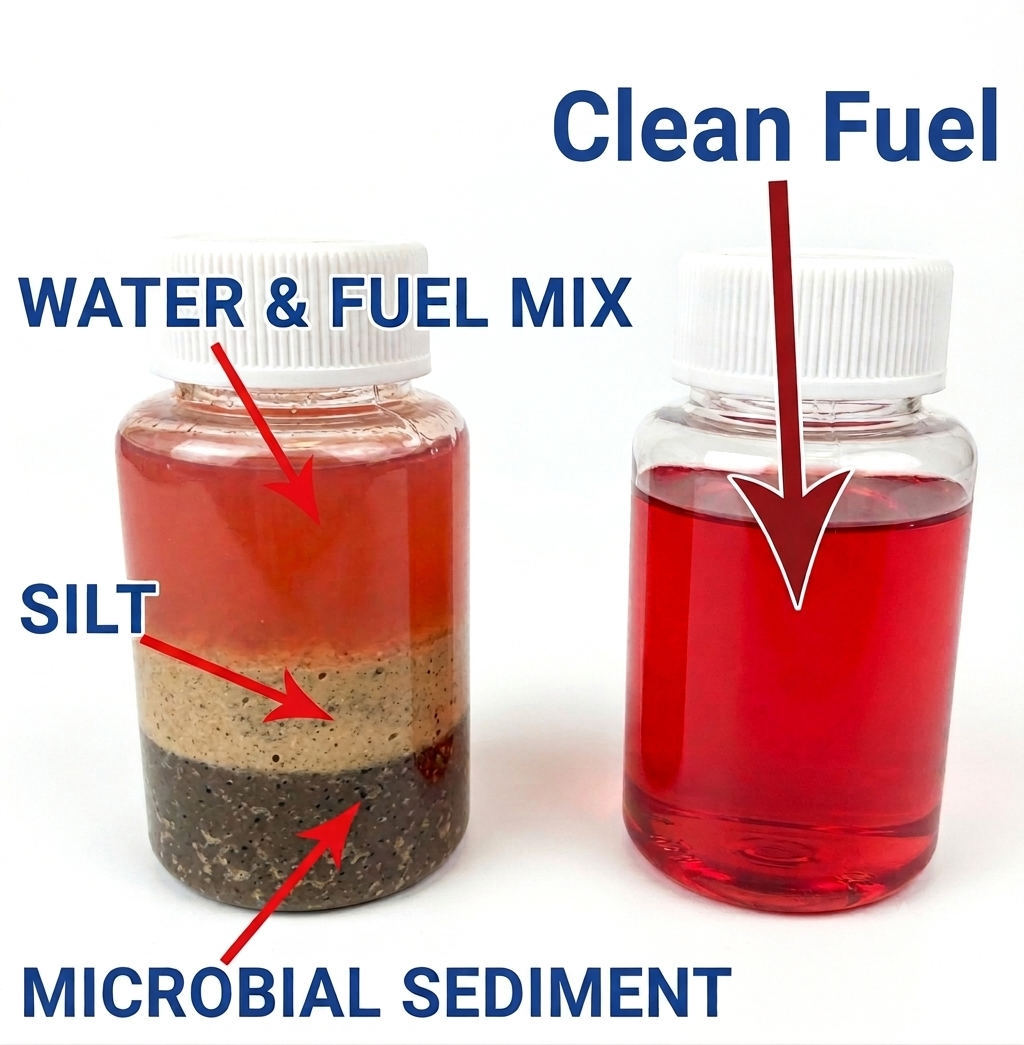
The most important thing to understand about diesel fuel contamination is that it isn’t one problem — it’s a family of distinct problems with different causes, different effects on equipment, different tests that detect them, and different remediation approaches. Treating contamination as a single generic issue leads to either overtesting (running every possible test on every sample) or undertesting (running a generic panel that misses the specific contaminant at hand).
The four primary contamination categories in diesel fuel each have a distinct fingerprint:
- Water contamination enters fuel through tank condensation (temperature cycling), delivery contamination, leaking fuel caps and fill seals, or high-humidity environmental conditions. Free water accumulates at the tank bottom and is measurable by ASTM D2709. Dissolved water remains dispersed throughout the fuel column at concentrations too low to form a visible separate phase but detectable by Karl Fischer titration (ASTM D6304). The practical monitoring threshold for dissolved water is approximately 200 ppm — above this level, conditions support microbial growth and injector corrosion even when no visible water layer is present at the tank bottom.
- Microbial contamination develops at the water-fuel interface wherever free or dissolved water provides the habitat microorganisms need. Bacteria and fungi colonize this interface, producing acidic metabolic byproducts that accelerate tank corrosion, generating sludge and biomass that plug fuel filters, and degrading fuel chemistry through enzymatic activity. ASTM D6469 opened its microbial guide with a statement that should command attention: "Uncontrolled microbial contamination in fuels and fuel systems remains a largely unrecognized but costly problem at all stages of the petroleum industry from crude oil production through fleet operations and consumer use." That sentence was written because microbial contamination is consistently underdiagnosed — and because ultra-low sulfur diesel (ULSD), the standard fuel since 2006, is meaningfully more susceptible to microbial contamination than its predecessors because the removal of sulfur compounds also removes natural antimicrobial protection.
- Particulate contamination enters diesel fuel from multiple sources: internal tank corrosion generating rust and metal oxide particles, microbial biomass breaking loose from colony sites, delivery contamination carrying sediment from upstream storage, and oxidation degradation products forming asphaltene and varnish particles. The practical harm from particulate depends heavily on engine injection system design — modern high-pressure common rail injection systems operate at tolerances far tighter than older mechanical injection systems, and particulate levels that caused no measurable harm in a 1990s-era diesel engine can damage a current-generation injector measurably.
- Cross-contamination from incompatible fluids — gasoline mixed into diesel, water mixed with fuel during handling, cleaning solvents or chemicals introduced through improperly rinsed equipment — creates a fourth category with characteristics unlike the storage-driven contamination types above. Cross-contamination often appears suddenly (following a delivery or maintenance event) rather than building gradually, and the analytical signature (dramatically low flash point for gasoline contamination, for example) is typically distinct from degradation-related contamination.
The Contamination Test Panel: What We Actually Measure
A well-designed diesel contamination testing panel matches the specific contaminants being investigated to the tests most sensitive to detecting them. This is why the first question in scoping a contamination test isn’t “what tests do you offer?” but “what symptoms or events prompted this testing?”
Core contamination screening panel:
Test | ASTM Method | What It Detects | Why It Matters |
Water & Sediment | D2709 | Free water and suspended solids by centrifuge | Primary pass/fail vs. ASTM D975 limit of 0.05% vol; quantifies visible contamination fraction |
Water by Karl Fischer | D6304 | Dissolved moisture at ppm level | Detects water below visible threshold; levels above 200 ppm create microbial and corrosion risk |
Microbial Contamination | D6469 | Bacteria and fungi | Detects active biological contamination; guides biocide treatment decisions |
Particulate Contamination | D2276 | Insoluble solids by gravimetric filtration | Quantifies filter and injector risk from solid contamination |
Flash Point | D93 | Minimum ignition temperature | Detects gasoline or solvent cross-contamination; below 52°C minimum is a safety and specification failure |
Visual / Clear & Bright | D4176 | Appearance, color, haze, visible particles | Baseline visual characterization documenting contamination visible to the eye |
Extended investigation panel (for complex or high-stakes events):
Test | ASTM Method | What It Adds |
ATP Bioluminescence | D7463 | Faster quantitative microbial screen than culture methods; detects total microbial metabolic activity |
Acid Number | D664 | Acidic degradation product accumulation from oxidation or microbial metabolic byproducts |
Oxidation Stability | D2274 | Predicts remaining storage life; determines whether oxidative degradation contributed to contamination |
Sulfur Content | D5453 | Verifies ULSD compliance; excludes higher-sulfur fuel cross-contamination |
API Gravity / Density | D1298 | Identifies density-shifting cross-contamination (e.g., significant gasoline blending) |
Distillation | D86 | Characterizes hydrocarbon boiling range; identifies blending or wrong-product contamination |
Reading the Contamination Fingerprint: How Test Results Identify Root Cause
Laboratory contamination results aren’t just a list of numbers — when interpreted together, they tell a story about where contamination came from and what it’s doing to the fuel. This pattern recognition is what distinguishes a useful contamination investigation from a list of pass/fail results.
- Pattern 1: Water + Microbes, gradual onset Water and sediment elevated, Karl Fischer dissolved water above 200 ppm, microbial count in the 10³–10⁴ CFU/mL range, particulate trending upward. Acid number slightly elevated. This pattern points to a long-developing storage contamination event: water entered over time (condensation, poor tank sealing), created conditions for microbial colonization, and the colony is now generating sludge and acidic byproducts. Remediation: water removal, fuel polishing, biocide treatment. Root cause: storage management issue, not supply chain.
- Pattern 2: High particulate, normal water, normal microbes Particulate well above expected baseline, water and microbial results acceptable, no flash point deviation. This pattern points to mechanical contamination — tank corrosion releasing particles, filter element failure, delivery equipment introducing external material, or an equipment maintenance event that disturbed settled sediment. The absence of elevated water and microbes rules out biological origin. Remediation: fuel polishing and filtration. Root cause investigation: examine filter elements, tank interior condition, recent delivery equipment.
- Pattern 3: Low flash point, normal water and microbes Flash point substantially below specification minimum (52°C for diesel), other contamination parameters unremarkable. This is a cross-contamination signature: gasoline or a light solvent has been introduced into the diesel fuel. Gasoline has a flash point well below zero Celsius — even a small gasoline fraction dramatically reduces the blended fuel's flash point below acceptable limits. This is a safety issue as well as a fuel quality issue. Root cause investigation: track fuel deliveries, examine dispensing equipment for cross-connection, investigate handling procedures.
- Pattern 4: Sudden appearance after delivery All parameters acceptable before delivery, contamination evident after delivery. Water, particulate, or flash point deviation appearing at a specific time that correlates with a fuel delivery. This is the pattern that supports supplier accountability — delivery verification testing data (a sample collected before the delivery entered the tank) is the definitive support for demonstrating that contamination arrived with the delivery rather than developing in the tank.
Microbial Contamination: The Most Misdiagnosed Diesel Problem
Microbial fuel contamination deserves extended discussion because it’s simultaneously the most damaging common diesel contamination type and the one most consistently misdiagnosed in equipment maintenance records.
Microorganisms in diesel fuel require water to grow and reproduce. Without a water phase, fuel-contaminating bacteria and fungi can survive but cannot proliferate to damaging levels. This means microbial contamination is always, at its root, a water management problem — but by the time microbial contamination is detected, it often appears as a filter problem (repeated filter changes), a fuel pump problem (reduced flow), or an injector problem (reduced atomization quality), because the biomass and metabolic products are what physically damage equipment, not the microorganisms themselves.
Microbial colonies grow exponentially when conditions favor them. ASTM D6974 culture methods detect live organisms by counting colonies grown on culture medium — a thorough but slow method (results in days, not hours). ASTM D7463 ATP (adenosine triphosphate) bioluminescence provides a faster alternative: ATP is produced by all living cells, and its presence at detectable levels indicates active biological contamination even before organism populations reach levels detectable by culture methods. ATP testing is particularly valuable as a monitoring tool between quarterly culture-based tests.
Quantitative interpretation thresholds:
- Below 10³ CFU/mL: Low-level contamination; monitor, maintain good water management
- 10³–10⁴ CFU/mL: Active contamination requiring biocide treatment and water removal
- Above 10⁴ CFU/mL: Severe contamination; aggressive remediation required; fuel may need replacement if contamination is entrenched
The industry standard biocide approach targets both the fuel phase (where hydrocarbon-metabolizing bacteria live) and the water phase (where sulfate-reducing bacteria and other anaerobic organisms colonize). Not all biocides are effective against both phases — test results identifying the specific contamination profile help guide appropriate biocide selection.
Cross-Contamination: The Contamination Type That Arrives Suddenly
Cross-contamination differs from storage-driven contamination in one critical way: it happens at a moment in time (a delivery, a filling event, a maintenance procedure) rather than developing gradually. This temporal characteristic is diagnostically important — if test results show a sudden, dramatic change in a parameter that had previously been stable, cross-contamination is more likely than degradation.
Common diesel cross-contamination events:
- Gasoline into diesel: Immediate, dramatic reduction in flash point; also reduces cetane and lubricity. Safety risk during storage and handling, and potential engine damage from reduced lubricity and different combustion characteristics
- Diesel exhaust fluid (DEF) into diesel: A real, documented contamination event (the FAA issued a Safety Alert for aviation fuel operations addressing this specific scenario). DEF is a urea-water solution. In diesel fuel, DEF contamination causes gelling, filter plugging, and fuel pump damage. DEF contamination is detected by elevated nitrogen compounds and characteristic chemical tests
- Wrong grade diesel: Off-road (dyed) diesel in on-road equipment, No. 1 diesel in equipment specified for No. 2, biodiesel blend above approved level — these are grade contamination events detectable by density, distillation, and infrared analysis
- Water from equipment cleaning: Residual water in a newly cleaned tank or repaired fuel system introduced during a maintenance event — detectable by Karl Fischer before the water has settled
When Diesel Contamination Testing Supports an Insurance Claim or Warranty Investigation
Laboratory diesel contamination testing with documented chain-of-custody handling provides the analytical basis for several business and legal situations beyond routine quality monitoring:
- Equipment warranty claims: An injector manufacturer will not accept a warranty claim without evidence that injector damage was a design or manufacturing defect rather than the result of fuel quality outside the engine manufacturer's specifications. Laboratory documentation of particulate levels, water content, and microbial contamination at the time of failure is often the key evidence in distinguishing warranted from non-warranted failure.
- Fuel supplier disputes: When a contaminated fuel delivery causes equipment damage across a fleet, supplier accountability requires evidence that the contamination was present in the delivered fuel — not that it developed afterward in the storage system. Delivery verification samples (tested at receipt) and retained storage samples (tested after contamination was discovered) together build the timeline evidence needed for a supplier dispute.
- Insurance claims: Equipment damage from contaminated fuel is potentially covered under commercial or equipment insurance policies, but coverage requires documentation that the damage was caused by an external event (fuel contamination) rather than normal wear or operator negligence. Laboratory contamination analysis with chain-of-custody documentation is the standard evidence package for fuel-contamination-related insurance claims.
Who Uses Diesel Contamination Testing
- Fleet managers and equipment operators investigating clusters of filter failures, injector failures, or fuel system problems that may trace to a common fuel source.
- Fuel distributors and rack terminal operators investigating customer quality complaints and verifying that contamination reported by a customer originated upstream or downstream of delivery.
- Diesel repair shops and service providers seeking to determine whether fuel quality is contributing to repeat failure patterns before completing warranty-questionable repairs.
- Insurance adjusters and claims investigators building documentation packages for equipment damage claims where fuel quality is a potential contributing factor.
- Tank cleaning and fuel polishing companies establishing before-and-after documentation of contamination levels to demonstrate service effectiveness.
- Facility managers following an NFPA 110 generator fuel quality failure, conducting extended investigation to identify root cause before restarting a generator fuel quality program.
How to Submit a Diesel Contamination Test Sample
Standard turnaround: 3–5 business days. Rush turnaround available for active investigations.
- Contact us to describe the situation — what symptoms or events prompted testing, what equipment is affected, and what you know about recent fuel history. This helps us recommend the most targeted panel rather than a generic catch-all test package.
- Receive your sample kit — clean, sealed containers with chain-of-custody documentation forms where legally or contractually relevant
- Collect samples properly:
- For storage tank investigation: collect from the tank bottom (where water and sediment concentrate) AND a mid-tank sample (bulk fuel quality)
- For delivery investigation: retain a sample from the delivery truck or tanker before fuel enters your tank — this is the most valuable single sample for supplier accountability
- Label every sample with location, date and time, tank ID or equipment identifier, and any relevant observations (odor, color, visible sediment)
- Ship samples using the prepaid return label provided with your kit
- Receive your Certificate of Analysis with results, ASTM comparisons, contamination pattern interpretation, and remediation guidance
Standard turnaround: 3–5 business days. Rush 24–48 hour available for active equipment incidents.
Testing conducted through Sterling Analytical, established 1957, West Springfield, Massachusetts.
Request a Quote
Verify Aviation Fuel Quality with ASTM-Certified Laboratory Testing
Whether you need incoming fuel verification, misfueling investigation, Jet-A quality assurance, Avgas 100LL specification testing, or support for an aircraft incident investigation, our laboratory team can recommend the appropriate ASTM testing package for your application.
Frequently Asked Questions
Water (both free and dissolved), microbial contamination (bacteria and fungi growing at the water-fuel interface), particulate matter (from tank corrosion, microbial residue, or delivery contamination), and cross-contamination from incompatible fluids (most commonly gasoline, DEF, or cleaning residuals).
Colony counts above 10³ CFU/mL indicate active microbial growth requiring biocide treatment and water removal. Counts above 10⁴ CFU/mL indicate severe contamination requiring aggressive remediation; fuel may need replacement if contamination is entrenched.
Sometimes, but unreliably. Visible water layers, dark color, visible sludge, and unusual odor are warning signs. However, dissolved water, early-stage microbial contamination, particulate below visible threshold, and cross-contamination with small volumes of gasoline may all be present at damaging levels without producing visible changes.
Only by having a sample collected at delivery, before the fuel enters your storage system. A delivery verification sample collected upstream of your tank, combined with periodic storage monitoring results, creates the before-and-after timeline needed to attribute contamination to a supply event versus storage development.
Ultra-Low Sulfur Diesel, the standard highway fuel since 2006, is more susceptible to microbial contamination than predecessor formulations because the deep hydrotreating process that removes sulfur also removes naturally occurring antimicrobial sulfur compounds. This means stored ULSD in warm, humid environments requires more active water management and more frequent microbial monitoring than older diesel formulations did.
Water and particulate contamination is typically remediable through fuel polishing (filtration and water removal). Microbial contamination requires biocide treatment plus fuel polishing to remove biomass. Severely degraded fuel with entrenched microbial contamination, high acid number, or significant off-specification chemistry may need to be replaced. Our COAs include remediation guidance for each specific result profile.
Quick Contact
If you have any questions or need help, feel free to contact with our team.
Send Us Email:
Call Us Today: