Phone:
(413) 214-6541
Location:
15 Agawam Ave West Springfield, MA 01089
Mon - Fri:
8.00am - 7.00pm
Parent Website:
sterlinganalytical.com

Fuel Stabilizer Testing
Diesel Fuel Lab provides fuel stabilizer testing — laboratory verification of diesel fuel oxidation stability before and after fuel stabilizer additive treatment, using ASTM D2274 (Standard Test Method for Oxidation Stability of Distillate Fuel Oil — Accelerated Method) and complementary stability tests. Our testing is conducted through Sterling Analytical, serving fuel storage managers, additive manufacturers, fuel distributors, emergency preparedness programs, and anyone who needs documented confirmation that a fuel stabilizer treatment achieves meaningful improvement in stored diesel fuel stability.
Fuel stabilizer testing occupies a parallel position to cetane improver testing in the additive verification workflow: just as a cetane improver treatment can only be verified by actually measuring the fuel’s ignition quality before and after treatment, a fuel stabilizer treatment can only be verified by actually measuring the fuel’s oxidation stability before and after treatment. Marketing claims on a stabilizer product bottle don’t substitute for a laboratory test showing the specific stability improvement achieved on your specific base fuel.
What Fuel Oxidation Stability Means — And Why It Matters More for ULSD
Oxidation stability is a measure of how resistant a diesel fuel is to chemical degradation when exposed to oxygen over time. When diesel fuel oxidizes in storage, the reaction between dissolved oxygen and fuel hydrocarbons produces a cascade of breakdown products: peroxides form first, then decompose to gums, varnish, and eventually asphaltene precipitates — the dark, sticky, insoluble material that coats injectors, clogs filters, and accumulates as sludge at the bottom of storage tanks.
The natural antioxidant compounds that would slow this oxidation process in older high-sulfur diesel formulations were largely removed by the hydrotreating process that produced ULSD. This removal is documented consistently across technical literature: hydrotreating removes sulfur at the expense of naturally occurring antioxidant compounds, leaving ULSD with meaningfully less inherent oxidation resistance than predecessor formulations. The practical consequence is that untreated ULSD stored in typical conditions can begin showing measurable oxidative degradation within 6–12 months — substantially faster than older diesel under equivalent conditions.
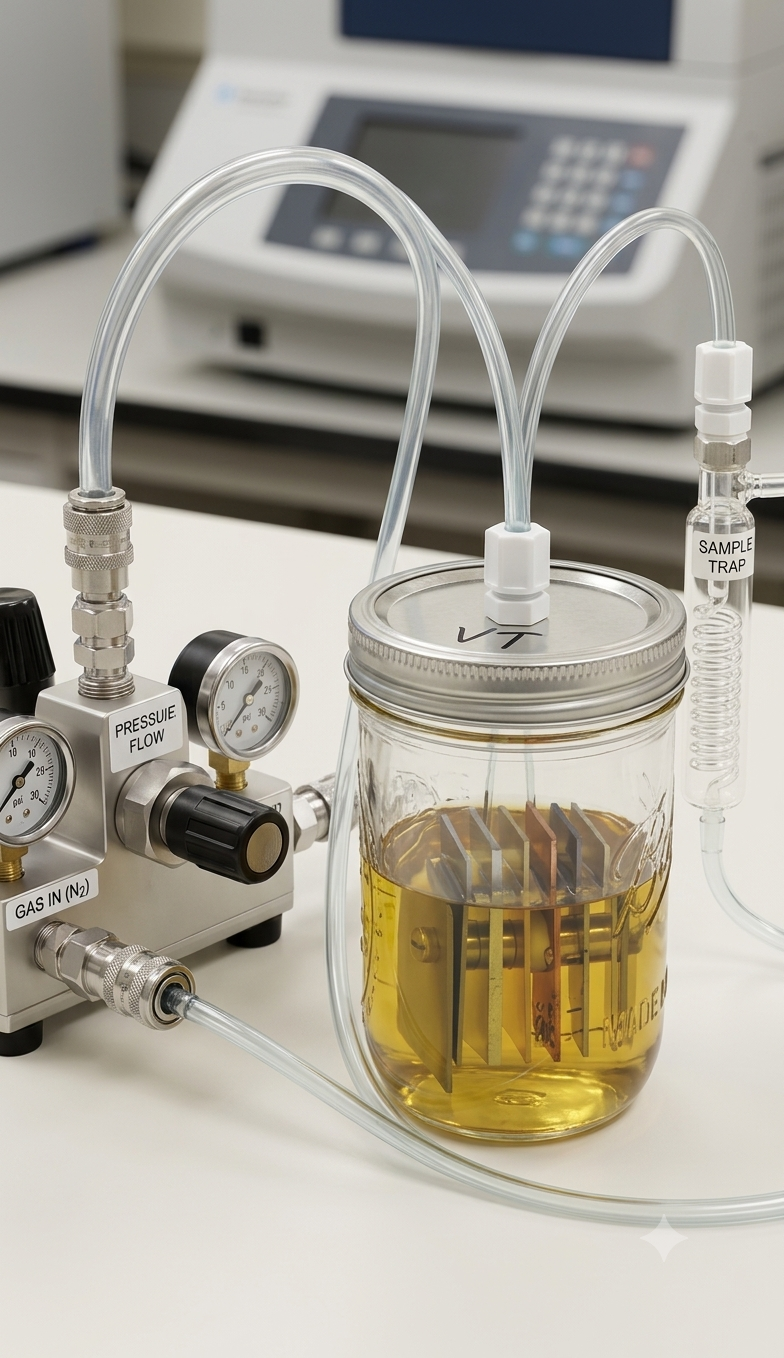
The test procedure: A 350 mL volume of filtered fuel sample is placed in a borosilicate glass oxidation cell and heated to 95°C (203°F). Pure oxygen is bubbled continuously through the liquid at a rate of 3.0 liters per hour for 16 hours. After the 16-hour aging period, the sample is cooled to room temperature, then filtered to capture the filterable insolubles that have formed. Additional adherent insolubles are removed from the glass surfaces of the oxidation cell using a trisolvent wash. Both fractions are weighed and the results are combined and reported as total insolubles in mg/100 mL.
The ASTM D2274 Test: What It Measures and How It Works
ASTM D2274 (Standard Test Method for Oxidation Stability of Distillate Fuel Oil — Accelerated Method) is the primary laboratory tool for assessing diesel fuel oxidation stability. Understanding how the test works — and what its limitations are — is essential for interpreting results correctly.
The test procedure: A 350 mL volume of filtered fuel sample is placed in a borosilicate glass oxidation cell and heated to 95°C (203°F). Pure oxygen is bubbled continuously through the liquid at a rate of 3.0 liters per hour for 16 hours. After the 16-hour aging period, the sample is cooled to room temperature, then filtered to capture the filterable insolubles that have formed. Additional adherent insolubles are removed from the glass surfaces of the oxidation cell using a trisolvent wash. Both fractions are weighed and the results are combined and reported as total insolubles in mg/100 mL.
The acceptance threshold: A result of less than 1.5 mg/100 mL total insolubles is generally considered acceptable for diesel fuel in storage applications. Higher values indicate that the fuel’s oxidation chemistry is producing gums and sediment at a rate that will cause filter and injector problems during the storage period the test simulates.
The simulation assumption: ASTM D2274 is commonly described as simulating approximately one year of diesel fuel storage under typical conditions — which is the context that makes the test directly relevant to annual fuel storage assessment for standby generator fuel and other long-term storage programs. The 16-hour test at elevated temperature and oxygen pressure accelerates the same chemical reactions that occur more slowly at ambient storage conditions, providing a result in hours rather than months.
The Critical Limitation of ASTM D2274 That Every User Should Understand
This is important enough to state clearly, because the ASTM standard itself states it explicitly and it affects how D2274 results should be interpreted: ASTM D2274 may not provide a prediction of the quantity of insolubles that will form in field storage over any given period of time.
This caveat, stated in the “Significance and Use” section of the standard, exists because the accelerated test conditions — 95°C temperature, pure oxygen atmosphere — can produce different types and quantities of insolubles than the same fuel would produce under actual ambient storage conditions over 12 months. The oxidation chemistry that occurs at 95°C in pure oxygen is not precisely equivalent to the oxidation chemistry at 20°C in air, even after applying a time-equivalent correction.
What D2274 reliably provides is a comparative assessment — comparing one fuel’s oxidation tendency against another, or comparing the same fuel before and after stabilizer treatment. This comparative function is exactly what fuel stabilizer testing requires: not an absolute prediction of how long the fuel will last, but a documented comparison showing whether stabilizer treatment improved the fuel’s oxidation stability and by how much.
For applications requiring closer simulation of actual field storage conditions, ASTM D4625 (the 43°C bottle test) stores fuel at 43°C for 12 weeks — a much slower test that uses gentler conditions closer to actual storage but takes three months to complete. For most practical fuel stabilizer verification programs, D2274 provides the actionable, timely result that D4625’s twelve-week timeline makes impractical.
Alternative Oxidation Stability Test Methods
Different applications and evaluation contexts call for different stability methods:
Method | Conditions | Duration | Application |
ASTM D2274 | 95°C, pure O₂ bubble, 350 mL | 16 hours | Standard diesel fuel storage stability; most common for before/after stabilizer testing |
ASTM D4625 | 43°C, ambient storage, 400 mL | 12 weeks | Closer to field conditions; used when D2274 results need real-world validation |
ASTM D5304 | 90°C, 100 psig O₂ overpressure, 100 mL | 16 hours | Alternative accelerated method; sometimes used for comparison |
ASTM D873 | 95°C, oxygen bomb | 6 hours | Aviation gasoline oxidation stability |
EN 15751 / ASTM D7462 | Rancimat method | Hours | Biodiesel (FAME) oxidation stability |
For standard ULSD diesel stabilizer testing, ASTM D2274 is the appropriate method and the one referenced in most fuel storage program documentation. Biodiesel blends (B5 and higher) may benefit from supplementary EN 15751 (Rancimat) testing given biodiesel’s distinct oxidation chemistry.
Fuel Stabilizer Chemistry: What Antioxidants Actually Do in Diesel
Understanding the chemistry behind fuel stabilizer additives helps frame what the laboratory test is actually measuring — and why the distinction between untreated and treated fuel is meaningful at the molecular level.
Diesel fuel oxidation follows a free radical chain reaction mechanism. Oxygen reacts with reactive hydrocarbon sites in the fuel to form peroxy radicals, which propagate the chain by reacting with additional fuel molecules. This chain reaction, once initiated, continues and accelerates until either available oxygen or susceptible hydrocarbons are consumed, or until a chain-breaking event occurs.
Antioxidant additives in fuel stabilizers act as chain breakers: they donate hydrogen atoms to peroxy radicals, converting them to stable hydroperoxides and interrupting the chain before it propagates further. In this mechanism, the antioxidant molecule is consumed — one antioxidant molecule typically interrupts one chain event. This means antioxidant additives have a finite capacity: they work until they’re depleted, after which oxidation proceeds at essentially the same rate as untreated fuel.
This stoichiometric consumption pattern has two practical implications for fuel stabilizer testing:
First: dose matters. A stabilizer added at too low a concentration depletes quickly and provides limited benefit over the intended storage period. A correctly dosed stabilizer maintains antioxidant presence throughout the intended storage window. Laboratory before/after testing at the intended dose rate verifies whether the dose is adequate.
Second: stabilizer added to already-oxidized fuel has limited effect. Antioxidants interrupt chain propagation — they cannot reverse oxidation products that have already formed. As stated in our Diesel Fuel Contamination for Long Term Storage page, adding stabilizer to degraded fuel is like painting over a rotting surface. Testing before adding stabilizer establishes whether the base fuel is in a condition where stabilizer can be effective, or whether the fuel is already too degraded for antioxidant treatment alone to address.
The Before/After Testing Protocol for Fuel Stabilizer Verification
The testing protocol that provides useful fuel stabilizer information follows the same paired-sample approach as cetane improver verification:
Step 1: Test base fuel (before treatment)
Run ASTM D2274 on the untreated fuel to establish the baseline oxidation stability. A base fuel with very poor stability (high D2274 insolubles) that has already undergone significant oxidation may not be recoverable with stabilizer treatment — the antioxidants are being asked to interrupt a chain reaction that’s already well advanced.
Step 2: Add stabilizer at intended dose rate and mix thoroughly
The stabilizer additive must be thoroughly blended into the fuel before sampling the treated product. Inadequate mixing produces an unrepresentative treated sample.
Step 3: Test treated fuel
Run ASTM D2274 on the treated fuel. Compare the insolubles result to the base fuel baseline.
Step 4: Interpret the result
The difference between base fuel and treated fuel insolubles represents the stability improvement achieved by the specific additive at the specific dose on the specific base fuel. A treated fuel showing insolubles below 1.5 mg/100 mL that was above 1.5 mg/100 mL untreated demonstrates that the stabilizer treatment brought the fuel within acceptable storage stability range.
What the test cannot confirm:
D2274 before/after testing confirms whether a stabilizer improves oxidation stability under the specific test conditions. As noted above, the standard explicitly states that D2274 results are not direct predictors of real-world field storage performance. The before/after comparison is the reliable information; the absolute insoluble level is an indicator, not a guarantee of a specific storage life extension.
Dose-Response Considerations: Why More Isn't Always Better
Research on antioxidant dose-response in diesel fuel stability has produced a finding worth understanding: the relationship between antioxidant dose and stability improvement is not linear, and increasing stabilizer dose above an effective threshold does not always produce proportional additional benefit.
NREL research on biodiesel antioxidant dose-response (a relevant analogy given biodiesel’s similar free radical oxidation chemistry) showed instances where a relatively low antioxidant dose was adequate in the long-term D4625 test but a higher dose in the accelerated D2274 test did not fully stabilize the same fuel. This reflects both the non-linearity of antioxidant chemistry and the fact that different test temperatures and oxygen concentrations can favor different oxidation pathways.
For practical fuel stabilizer program design, this means: adding more stabilizer than recommended does not necessarily provide more protection, and the recommended dose on a product label reflects the manufacturer’s testing on reference fuels that may respond differently than your specific ULSD batch. Laboratory before/after testing on your actual fuel at your intended dose rate is the only way to confirm adequacy for your specific situation.
Who Needs Fuel Stabilizer Testing
Emergency generator and critical facility operators adding fuel stabilizer to standby generator diesel to extend storage life beyond 12 months, who need documented proof that treatment improved stability before relying on treated fuel in an emergency.
Emergency preparedness and disaster response programs maintaining strategic diesel reserves for extended periods, where stabilizer treatment effectiveness documentation supports fuel quality program records.
Fuel additive manufacturers and product developers characterizing new or existing stabilizer formulations across different base fuel types, establishing dose-response data, and comparing products.
Fuel distributors offering stabilizer-treated premium stored-fuel products to facility manager customers, using before/after testing to document and defend the quality claim of their treated product.
Agricultural and seasonal equipment operators treating bulk diesel fuel that will sit through an off-season, verifying that treatment achieves meaningful stability improvement before relying on the treated fuel for equipment-critical spring operations.
Military and government fuel programs maintaining documented quality assurance programs for strategic fuel reserves, including additive treatment verification.
How to Submit a Sample for Fuel Stabilizer Testing
- Contact us to specify your testing scope — base fuel only, before/after paired verification, full stored fuel assessment with stabilizer testing, or dose-response characterization
- Receive your sample kit — clean containers for both the untreated base fuel sample and the treated fuel sample
- Collect samples:
- Base fuel sample: collect from tank before stabilizer addition, filling the container completely to minimize headspace and oxygen contact
- Treated fuel sample: after stabilizer addition and thorough mixing throughout the tank (allow adequate circulation time), collect from the same sampling point as the base fuel sample
- Label each sample: base vs. treated, stabilizer product name and dose rate, fuel grade, tank ID, collection date
- Ship samples using the prepaid return label
- Receive your Certificate of Analysis with D2274 insolubles for both base and treated fuel, comparison against the 1.5 mg/100 mL threshold, and interpretation of the stability improvement achieved
Standard turnaround: 3–5 business days from laboratory receipt. Rush service available.
Testing conducted through Sterling Analytical, established 1957, West Springfield, Massachusetts. Visit sterlinganalytical.com →
Fuel Stabilizer Testing
Submit your fuel stabilizer sample along with details about the fuel type, storage conditions, treatment dosage, storage duration, and any observed issues such as fuel degradation, gum formation, oxidation, phase separation, corrosion, or reduced engine performance. We’ll recommend the most appropriate testing panel to evaluate stabilizer effectiveness and provide detailed results with interpretation and recommendations to help maintain fuel quality, extend storage life, and protect equipment performance.
Testing is conducted through Sterling Analytical in West Springfield, established in 1957.
Frequently Asked Questions
ASTM D2274 measures oxidation stability of middle distillate fuel (diesel, No. 2 fuel oil) by bubbling oxygen through a heated fuel sample at 95°C for 16 hours, then measuring the filterable and adherent insolubles formed. Results below 1.5 mg/100 mL are generally considered acceptable for storage applications.
ASTM D2274 is commonly described as simulating approximately one year of fuel storage. However, the ASTM standard itself explicitly states that D2274 may not provide a precise prediction of the quantity of insolubles that will form in actual field storage, due to differences between accelerated test conditions and real storage environments.
D4625 stores fuel at 43°C for 12 weeks — gentler conditions closer to actual field storage, which some researchers consider produces more realistic results. The trade-off is time: D4625 requires three months, while D2274 provides a result in 16 hours. D2274 is more practical for most fuel stabilizer verification programs.
No. Antioxidant stabilizers interrupt ongoing oxidation chain reactions but cannot reverse oxidation products — gums, varnish, and asphaltenes — that have already formed. Stabilizer is most effective when added before or at the early onset of oxidation. Fuel with advanced oxidation (high D2274 insolubles in the base fuel) may need fuel polishing to remove existing degradation products alongside stabilizer treatment to prevent further degradation.
Not proportionally. Antioxidant dose-response is not perfectly linear. Research has shown cases where higher doses in accelerated testing did not provide proportional additional stability compared to lower doses in real-world testing, and vice versa. Laboratory verification at your intended dose rate on your actual base fuel is the most reliable way to confirm adequacy
Yes. Biodiesel (FAME) has different oxidation chemistry than petroleum diesel and is generally less stable in storage. Biodiesel blends benefit from supplementary testing by EN 15751 (Rancimat method) alongside or instead of ASTM D2274, and antioxidant additive response may differ from pure diesel response.
Quick Contact
If you have any questions or need help, feel free to contact with our team.
Send Us Email:
Call Us Today: