Phone:
(413) 214-6541
Location:
15 Agawam Ave West Springfield, MA 01089
Mon - Fri:
8.00am - 7.00pm
Parent Website:
sterlinganalytical.com
Standby Generator Diesel Fuel Testing
Diesel Fuel Lab provides certified standby generator diesel fuel testing for facilities that depend on emergency and backup power systems to perform without failure. Hospitals, data centers, municipalities, industrial plants, and commercial buildings trust our laboratory to deliver accurate, ASTM-certified analysis of stored diesel fuel — the analysis that confirms your generator will actually start when the power goes out.
Standby generator fuel rarely gets used. It sits in storage tanks for months or years, degrading silently while your equipment waits for an emergency that may never come — until one day it does. By the time degraded fuel causes a generator failure during a real power outage, it’s too late for testing. The goal of annual standby generator diesel fuel testing is to catch that degradation before the emergency, while there’s still time to remediate, treat, or replace the fuel.
This isn’t bureaucratic box-ticking. When stored diesel fuel fails in a standby generator, real consequences follow.
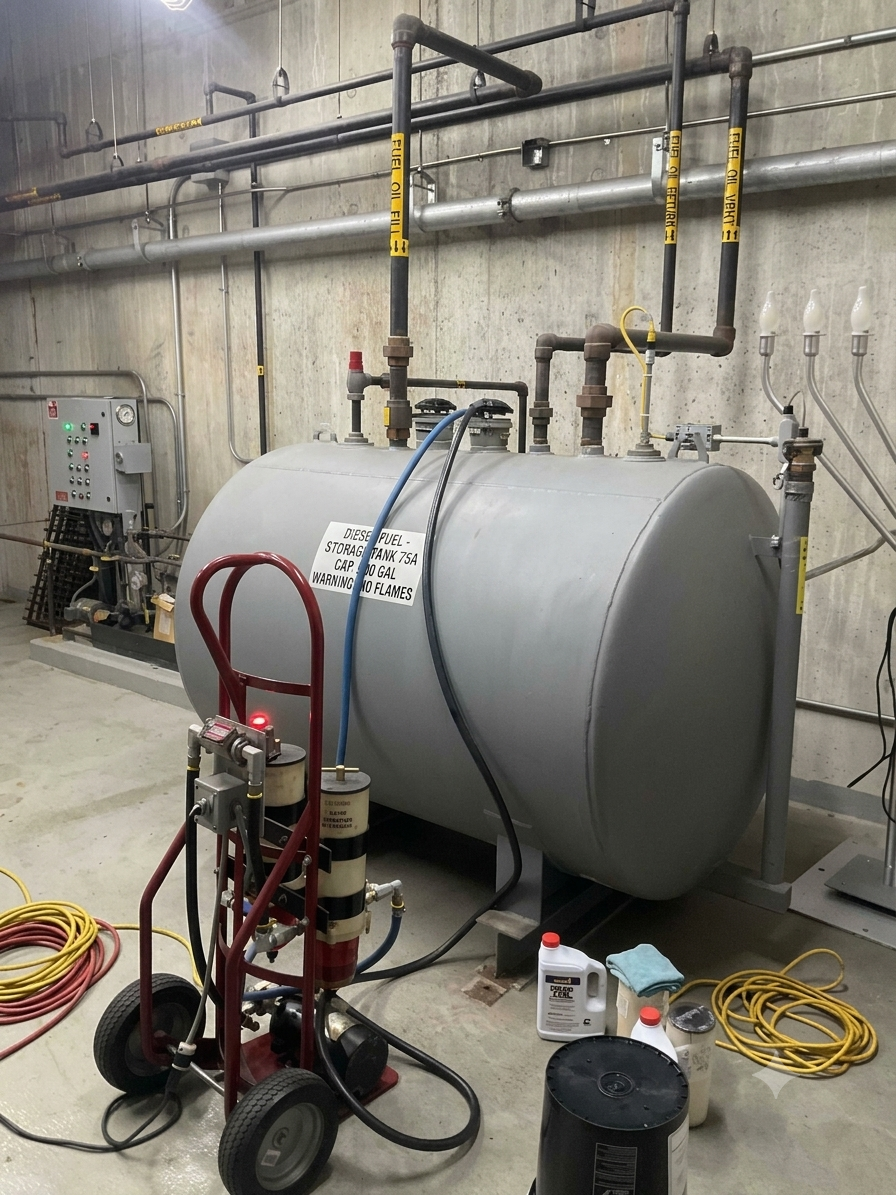
Why Generator Fuel Testing Cannot Wait: What Fuel Failure Actually Looks Like
In September 2017, Hurricane Irma knocked out power to a nursing home in Hollywood, Florida. The backup generator failed — not because of a mechanical problem, not because of maintenance neglect, but because the stored diesel fuel had degraded to the point where it could not sustain operation. Twelve elderly residents died in the sweltering heat before help arrived. Investigations afterward showed the fuel itself was the failure point.
That tragedy is not an isolated case. Survivors of Superstorm Sandy and Hurricane Katrina document similar generator failures across critical facilities — hospitals, emergency operations centers, dialysis clinics — where backup systems that should have protected people instead failed because of fuel quality that had never been verified. The common thread through every one of these failures isn’t age, mechanical wear, or even poor scheduling. It’s stored diesel fuel that was never tested, degraded without anyone knowing, and was called upon to perform when it couldn’t.
Annual standby generator diesel fuel testing exists specifically to prevent this outcome. It exists because visual inspection of a fuel tank tells you almost nothing — degraded diesel fuel doesn’t look bad. It exists because by the time fuel degradation manifests as a visible problem, it has already progressed to the point where it’s dangerous to rely on.
What NFPA 110 Actually Requires — And Where the Confusion Comes From
NFPA 110 (Standard for Emergency and Standby Power Systems) is the governing standard for facilities that operate emergency generators. Section 8.3.7 of NFPA 110 states plainly: A fuel quality test shall be performed at least annually using appropriate ASTM standards.
That sentence seems simple. It isn’t.
NFPA 110 mandates annual testing but deliberately does not prescribe exactly which tests must be performed. Instead, it references ASTM D975 — the Standard Specification for Diesel Fuel Oils — and leaves interpretation of “appropriate ASTM standards” to the Authority Having Jurisdiction (AHJ) at your specific location. This means the answer to “which tests do I need?” depends partly on your state, your county, your local fire marshal, and your facility type.
The second complexity is that ASTM D975 was designed to evaluate freshly refined diesel fuel — the fuel leaving a refinery gate, not diesel that’s been sitting in a storage tank for eighteen months in a basement mechanical room. ASTM D975 covers 7 grades of diesel fuel, references 66 ASTM methods, and specifies 13 detailed test requirements. Of those 13 requirements, several are essentially irrelevant to stored fuel degradation (they test properties that don’t change meaningfully over time), while others are critically important for storage-specific failure modes that D975 doesn’t directly address at all.
This gap — between what ASTM D975 requires for fresh fuel and what stored standby generator fuel actually needs to be evaluated — is where most facilities get compliance wrong. Facilities that test only to the minimum D975 specification may be technically compliant while still missing the contamination and degradation patterns that most commonly cause generator failures in long-term storage conditions.
At Diesel Fuel Lab, we build standby generator diesel fuel testing packages around what stored fuel actually needs: an annual compliance package that meets NFPA 110 and ASTM D975 documentation requirements, plus the storage-specific tests that catch the failure modes most commonly found in emergency generator tanks.
How Stored Diesel Fuel Degrades: The Four Failure Modes
Diesel fuel in a standby generator tank faces four distinct degradation pathways, each of which can independently cause startup failure, injector damage, or sustained operation failure during an emergency:
- Oxidation and Sludge Formation Ultra-low sulfur diesel (ULSD), the standard fuel since 2006, oxidizes faster than older high-sulfur diesel formulations. Oxidation produces gums, varnish, and dark sludge that plug fuel filters, clog injectors, and prevent proper combustion. A generator that starts and runs for its monthly 30-minute load test may appear fine — but under the sustained full-load demand of a real emergency, a clogged fuel filter will stop it cold. Oxidation is invisible without laboratory testing.
- Water Intrusion and Condensation Storage tanks breathe. As temperatures cycle between day and night, humid air enters through tank vents, condenses on cooler metal surfaces, and accumulates as free water at the bottom of the tank. Even small amounts of free water create problems: emulsification with fuel, corrosion of metal tank surfaces, and — critically — a perfect habitat for microbial growth.
- Microbial Contamination Where water and fuel interface, bacteria and fungi grow. Microbial colonies form at the water-fuel boundary and produce acidic waste products that accelerate corrosion, create additional sludge, and cause filter restriction. Heavily contaminated fuel has a characteristic dark, foul-smelling appearance — but early-stage microbial contamination produces no visible change. By the time fuel looks or smells wrong, the contamination is already severe.
- Particulate Accumulation Tank rust, scale, microbial residue, and external contamination from fuel deliveries accumulate as particulate matter that clogs filters and injectors. A generator fuel filter rated for normal operation may not be sufficient to handle heavy particulate loads under extended emergency operation.
Our Standby Generator Diesel Fuel Testing Packages
Diesel Fuel Lab offers two structured testing packages specifically designed for standby generator applications, plus individual test add-ons for facilities with specific concerns.
Core Compliance Package — Meets NFPA 110 Annual Requirement
This package covers the ASTM-method testing required to document NFPA 110 compliance and evaluate the properties most likely to cause startup and operation failure in stored fuel:
- Clear & Bright — ASTM D4176: Visual clarity inspection identifying haze, suspended water, or visible particulate matter
- Water & Sediment — ASTM D2709: Centrifuge method quantifying free water and suspended solids; ASTM D975 requires below 0.05% vol/vol
- Water by Karl Fischer — ASTM D6304: Highly sensitive dissolved water detection, identifying moisture levels too low for centrifuge detection but sufficient to promote microbial growth.
- Flash Point — ASTM D93: Verifies diesel has not been contaminated with gasoline or other volatile hydrocarbons; reduced flash point is a safety concern and indicates cross-contamination
- Microbial Growth — ASTM D6469: Detects bacteria and fungi; early identification allows biocide treatment before contamination becomes severe
- Particulate Contamination — ASTM D2276: Gravimetric measurement of insoluble particulate matter that can restrict filters and damage injection systems
Many of these issues develop without visible signs, making routine impurity testing essential for maintaining performance and avoiding unplanned downtime.
Advanced Compliance Package — Complete Stored Fuel Evaluation
This package covers the ASTM-method testing required to document NFPA 110 compliance and evaluate the properties most likely to cause startup and operation failure in stored fuel:
Sample Quantity & Handling
For facilities subject to more demanding AHJ requirements, facilities that have not tested in more than 18 months, or facilities conducting investigation of a specific fuel concern:
All Core Compliance tests, plus:
- Distillation — ASTM D86: Characterizes the boiling range profile of diesel fuel; deviations indicate chemical breakdown or contamination
- API Gravity — ASTM D1298: Density measurement; significant deviation suggests contamination or degradation
- Copper Strip Corrosion — ASTM D130: Evaluates corrosive potential toward copper alloys in fuel system components
- Cetane Number Estimation — ASTM D976: Evaluates ignition quality and combustion performance; poor cetane leads to hard starts
- Cetane Index — ASTM D4737: Calculated cetane provides additional insight into aromatic content and ignition behavior
- Sulfur Content — ASTM D5453: Ultraviolet fluorescence analysis; verifies ULSD compliance (15 ppm max) and emission system compatibility
- Viscosity — ASTM D445: Kinematic viscosity affects injector spray pattern, lubrication, and pump wear
- Ash Content — ASTM D482: Inorganic residue contributing to combustion chamber deposits
- Carbon Residue — ASTM D524: Deposit-forming tendency under thermal stress
- Asphaltenes — AH-24A-ASP2: Identifies heavy insoluble fractions contributing to filter plugging and injector deposits
Who Needs Standby Generator Diesel Fuel Testing
Annual standby generator diesel fuel testing is not optional for facilities where backup power failure creates life safety risk. Facilities that fall under NFPA 110 compliance requirements include:
- Healthcare Facilities Hospitals, surgical centers, emergency departments, and long-term care facilities operate under the strictest NFPA 110 requirements. Level 1 EPSS designation means generator failure during an outage directly threatens patient lives. Annual fuel testing is not merely recommended — it is required and must be documented for Joint Commission accreditation and state health department compliance.
- Data Centers and IT Infrastructure Unplanned downtime at a data center costs an average of tens of thousands of dollars per minute, not accounting for SLA penalties, data loss, or reputational damage. Colocation facilities and enterprise data centers require documented proof of generator reliability for both compliance and customer contracts.
- Senior Living and Long-Term Care Facilities Assisted living facilities, nursing homes, and memory care units house residents who cannot self-evacuate during a power failure in extreme heat or cold. The regulatory and liability consequences of generator failure in these settings are severe — as the 2017 Florida nursing home case demonstrated.
- Industrial and Manufacturing Facilities Production environments rely on backup power to protect processes, equipment, and inventory from damage during outages. Planned maintenance testing may not identify fuel degradation that only manifests under extended full-load conditions.
- Commercial Buildings and High-Rise Properties Emergency lighting, elevators, fire alarm systems, and life safety equipment in commercial buildings require compliant backup power. Fire marshals and building inspectors increasingly request fuel testing documentation as part of routine inspections.
- Telecommunications and Critical Infrastructure Cell towers, communications hubs, water treatment facilities, and emergency services buildings require uninterrupted backup power. Many operate under contractual or regulatory requirements that specifically mandate annual fuel testing documentation.
How to Submit a Sample
Getting your fuel tested at Diesel Fuel Lab is a straightforward process:
- Contact us or order online to select the appropriate testing package
- Receive your sample kit — we ship a clean sample container and return packaging to you
- Collect your sample — pull a representative fuel sample from the bottom third of your storage tank; we provide detailed sampling guidance with every kit
- Ship your sample — drop in the mail or use the prepaid return label included in your kit
- Receive your results — we deliver a complete Certificate of Analysis (COA) with ASTM-referenced results, pass/fail designations, and remediation recommendations where applicable
Turnaround time: 3–5 business days from laboratory receipt. Expedited turnaround available.
What You Receive: Your Certificate of Analysis
Every standby generator diesel fuel testing submission returns a complete Certificate of Analysis (COA) suitable for NFPA 110 compliance documentation, AHJ inspection, insurance requirements, and operational records.
Your COA includes:
- All tested parameters with measured values and ASTM method references
- Pass/Fail designations against ASTM D975 limits where applicable
- Report values for storage-specific tests without fixed D975 limits
- Remediation recommendations where results indicate treatment or replacement is warranted
- Lab-signed documentation suitable for compliance record-keeping
Request a Quote
Ready to verify the condition of your standby generator fuel?
Submit your facility details and fuel testing requirements to receive a tailored quote and recommended testing package.
Frequently Asked Questions
NFPA 110 Section 8.3.7 requires annual testing at minimum. Higher-risk facilities — healthcare, critical infrastructure, facilities with known history of fuel quality issues — may test semi-annually. Any time fuel has been in storage for more than 12 months without testing, annual testing should be treated as overdue.
A failed result is not a reason to panic — it's exactly the early warning annual testing is designed to provide. Depending on which tests fail and by how much, remediation options include fuel polishing (filtration to remove water and particulate), biocide treatment (for microbial contamination), fuel stabilizer addition (for oxidation stability), or fuel replacement for severe degradation. We include remediation guidance with every COA.
No, and this is one of the most common points of confusion. NFPA 110 requires annual fuel quality testing using "appropriate ASTM standards" but does not prescribe a specific test package. The Authority Having Jurisdiction (AHJ) — your local fire marshal, building inspector, or relevant accrediting body — may have specific requirements for your facility type. Our Core Compliance Package is designed to satisfy the most common AHJ requirements; we can discuss your specific situation if you have an AHJ that has issued specific guidance.
ASTM D975 is the primary standard referenced by NFPA 110, but it was designed to evaluate freshly refined diesel fuel, not fuel in long-term storage. Several ASTM tests not included in D975 (Karl Fischer moisture, microbial testing) are specifically relevant to storage-related degradation and are included in our packages because they catch failure modes that a D975-only panel may miss.
Yes. We provide complete sampling instructions with every kit. For generator fuel, samples should be taken from the bottom third of the storage tank — not from the fill opening — since water and sediment accumulate at the lowest point. A sample from the top of the tank that looks clean may not represent what's actually in the bottom of the tank where degraded material settles.
Quick Contact
If you have any questions or need help, feel free to contact with our team.
Send Us Email:
Call Us Today: