Phone:
(413) 214-6541
Location:
15 Agawam Ave West Springfield, MA 01089
Mon - Fri:
8.00am - 7.00pm
Parent Website:
sterlinganalytical.com
Aircraft Fuel Testing
Diesel Fuel Lab provides aircraft fuel testing for both piston aircraft fuel (Avgas 100LL, governed by ASTM D910) and aviation turbine fuel (Jet-A and Jet-A1, governed by ASTM D1655) — the two fundamentally different fuel types that share airport infrastructure while serving entirely different engines with entirely different chemistry. Our laboratory testing is conducted through Sterling Analytical, providing ASTM-certified analysis for FBOs, flight schools, corporate flight departments, general aviation maintenance organizations, and investigators following fuel-related incidents.
Aircraft fuel testing occupies a unique analytical position: the materials being tested are used in systems where quality failure can be immediately and directly fatal, and where some of the most dangerous failure modes — misfueling, water contamination, particulate accumulation — are not reliably detectable by the visual inspection methods pilots and line personnel use at the aircraft before flight. Understanding what laboratory testing can confirm that a sump check cannot is essential context for everyone involved in handling or using aviation fuel.
Two Fuels, One Airport: Why the Avgas/Jet-A Distinction Is Life-Critical
Most ground transportation, industrial, and marine applications use one or two fuel types with broadly similar chemistry. Aviation is different: two fuel types with fundamentally incompatible chemistry share the same airport, the same FBO, and sometimes the same physical infrastructure — and the consequences of using the wrong one are catastrophic.
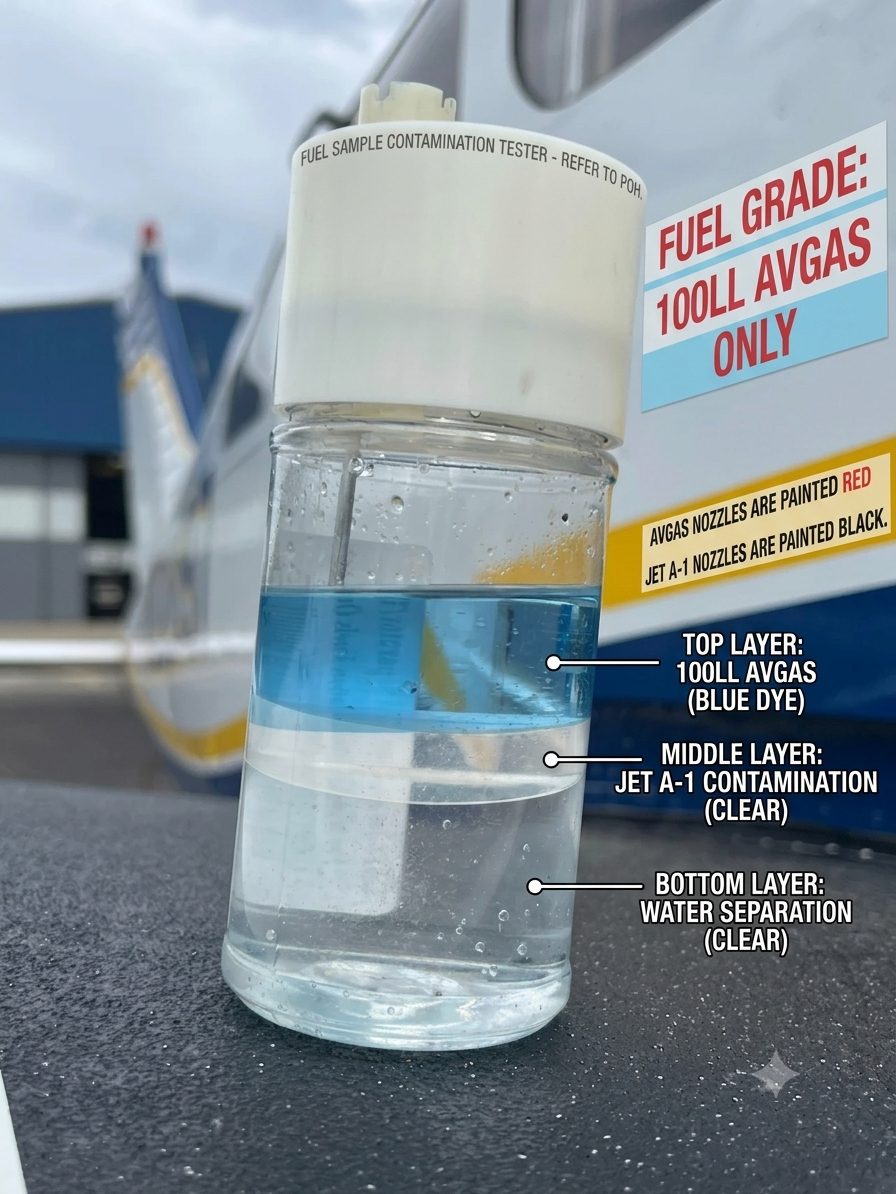
- Avgas 100LL (100 octane, low lead) is the fuel that powers the vast majority of piston-engine general aviation aircraft. It is dyed bright blue specifically to enable visual identification before it reaches an aircraft. Despite being called "low lead," 100LL contains 0.56 grams of tetraethyl lead per liter — making it the only remaining fuel in widespread commercial use anywhere in the world that still contains added lead as an anti-knock additive. ASTM D910 is the governing specification. High-octane avgas is essential for high-compression piston engines; the octane rating prevents destructive detonation during combustion.
- Jet-A is a kerosene-range turbine fuel used in turbine-powered aircraft — jets, turboprops, and turbine helicopters. It is clear to straw-colored, not dyed. ASTM D1655 is the governing specification. Jet-A has a much higher flash point than avgas (above 38°C vs. avgas around −23°C), lower volatility, and different combustion chemistry entirely suited to continuous-combustion turbine engines.
The visual identification system — blue for avgas, clear for Jet-A — exists precisely because misfueling is a documented, recurring accident cause. The stakes are not symmetrical: avgas into a turbine engine generally causes operational issues but may be manageable depending on quantity and engine type. Jet-A into a piston engine is frequently fatal. Jet-A’s octane rating is entirely inadequate for a high-compression piston engine. The engine may start and run initially, but Jet-A’s combustion properties cause detonation that destroys pistons, cylinders, and valves — sometimes catastrophically in flight. Fatal accidents from this specific error have occurred. Laboratory fuel testing is the definitive method for confirming what fuel type is actually in an aircraft or storage system when visual inspection alone is insufficient.
What Visual Inspection at the Aircraft Cannot Tell You
Pre-flight fuel sumping — pulling a sample from the drain point at the bottom of each fuel tank — is a standard pilot procedure and a genuinely useful first check. But it has specific, well-documented limitations that matter for understanding when laboratory testing provides information visual inspection cannot.
- Water settling takes time — approximately one hour. Water is denser than both avgas and Jet-A. When fuel is agitated — during fueling, during flight, or even during a fuel delivery — water disperses throughout the fuel rather than pooling visibly at the bottom where a drain sample would catch it. A patent document describing an onboard aircraft fuel contamination detection system cites the one-hour settling time explicitly as the reason pre-departure sumping can provide a false negative: an aircraft can take off before water has had time to settle to where a drain check would detect it. Laboratory testing of a fuel sample using Karl Fischer titration (ASTM D6304) detects dissolved and emulsified water regardless of whether it has settled — it finds the water in whatever form it's present, not just the form that's visible at the drain point.
- Small quantities of wrong fuel are not visually distinguishable. If a turbine aircraft's tanks contain mostly Jet-A with a small fraction of avgas — introduced through a fueling error — a visual sump check will show clear or slightly amber fuel that looks normal. The avgas contamination is detectable through flash point testing (avgas has a dramatically lower flash point than Jet-A) and distillation testing. It's not detectable by looking at the fuel.
- Surfactant and chemical contamination is invisible. The WSIM (Water Separation Index Modified) test described in the Jet Fuel Testing section of this site detects surfactants and emulsifiers in aviation fuel that cause water separators and filter/coalescers to fail. These contaminants don't change how fuel looks, smells, or behaves at the drain point — but they cause fuel-water separator failures that allow water to reach aircraft fuel system components downstream.
- Particulate contamination at relevant concentrations is invisible. Fuel filter manufacturers typically use ISO cleanliness codes to rate filter element capacity, and the particulate levels at which aircraft fuel system components are damaged are well below what's visible to the naked eye in a fuel sample. Laboratory gravimetric filtration (ASTM D5452) quantifies particulate at the concentrations that matter for component protection.
Avgas 100LL Testing: ASTM D910 Specification Parameters
ASTM D910 (Standard Specification for Aviation Gasolines) governs the quality requirements for 100LL and other avgas grades. Unlike the turbine fuel specification (ASTM D1655), avgas testing must account for the unique chemistry of a high-octane leaded piston engine fuel — including the lead content itself, the specific octane requirements for detonation resistance, and the volatility properties suited to piston engine carburetors and fuel injection systems.
Key ASTM D910 parameters for 100LL:
Parameter | ASTM Method | D910 Limit | Significance |
Knock Rating (Motor/Lean) | D2700 | 99.5 min (lean); 130 min (rich) | Detonation resistance — the core safety property |
Lead Content | D3341, D3343 | 0.56 g Pb/L nominal | Required for octane, critical for toxicity tracking |
Distillation | D86 | Multiple limits | Volatility for starting and vapor lock |
Vapor Pressure (Reid) | D323 | 38–49 kPa at 37.8°C | Fuel system vapor pressure management |
Density | D1298 | Specified range | Fuel metering accuracy |
Sulfur Content | D1266 | 0.05% mass maximum | Corrosion and deposit control |
Freezing Point | D2386 | −58°C maximum | Cold-weather operability |
Net Heat of Combustion | D4809 | 43.5 MJ/kg minimum | Energy delivery |
Water Reaction | D1094 | Interface rating 1b maximum | Water separation |
Oxidation Stability | D873 | Limits on peroxides and gum | Storage stability |
Color (Blue dye verification) | D2392 | Verified blue | Visual identification confirmation |
Lead content testing is particularly important in two contexts: confirming that avgas contains the correct lead level (too low affects octane; too high affects engine deposits and component compatibility in some aircraft), and when investigating incidents where lead contamination of a turbine fuel supply is suspected.
The Unleaded Avgas Transition: Testing Implications for 100LL Replacements
The aviation industry is currently in a significant transition away from 100LL toward unleaded avgas alternatives, and this transition has direct implications for fuel testing programs.
The FAA’s EAGLE (Eliminate Aviation Gasoline Lead Emissions) initiative has been working toward an unleaded replacement for 100LL for years. Two unleaded alternatives have received FAA Supplemental Type Certificate (STC) authorization for use in many piston aircraft: G100UL and GAMI G100UL. These fuels achieve the required anti-knock performance without lead through different hydrocarbon chemistry rather than tetraethyl lead additive.
The testing implications are real: G100UL and other unleaded alternatives have different specific gravity, distillation characteristics, and compositional profiles than 100LL, even though both are intended to serve the same engine in the same aircraft. A laboratory test result interpreted against 100LL D910 limits may not correctly characterize an unleaded replacement fuel’s quality, and the opposite is also true. As airports transition fuel supplies from 100LL to unleaded alternatives — a transition that is already underway at some locations and will expand significantly — laboratory testing programs need to account for which specific fuel grade is being tested and against which specification limits results are being compared.
This is not a hypothetical future concern: it’s an active transition happening at airports now, and fuel quality programs that don’t account for the specific grade being tested risk generating misinterpreted results.
Jet-A Aircraft Fuel Testing: The FBO and Flight Department Perspective
For turbine aircraft operators, aircraft fuel testing most commonly falls into three operational contexts:
- Incoming fuel verification at a fuel farm or on-site storage. Corporate flight departments, charter operators, and charter terminals that maintain their own Jet-A fuel storage need to verify that fuel arriving by truck matches the Certificate of Analysis from the supplier and that delivery didn't introduce contamination through equipment or handling. Flash point, water content, particulate, and visual inspection (ASTM D4176) are the core parameters for incoming receiving tests.
- Investigation of a fuel-related anomaly or incident. When a turbine aircraft experiences an anomalous fuel system indication, unusual engine behavior, fuel filter restriction, or fuel-related maintenance finding, laboratory testing of remaining fuel provides data to include or exclude fuel quality as a contributing factor. JFTOT thermal stability testing, water separation (WSIM), particulate quantification, and full D1655 specification testing provide the comprehensive picture needed for a maintenance investigation.
- Quality verification at a fuel quality event. When an airport or FBO experiences a potential misfueling event, quality control failure, or receipt of fuel suspected to be off-specification, immediate laboratory testing is the required response before the fuel supply can be returned to service. In these situations, chain-of-custody documentation and complete specification testing are both important.
Critical Aircraft Fuel Sampling: Why the Procedure Matters
ASTM D6379 sampling protocols for aviation fuel specifically require representative samples from tank bottoms, mid-levels, and surface areas — not single-point sampling — because stratified contamination patterns (water at the bottom, surfactant-emulsified water at mid-levels, oxidation products at the surface) require multiple sample points to detect reliably.
This is particularly relevant for aircraft fuel tank sampling: the sump drain at the lowest point of an aircraft tank captures the bottom-of-tank fraction, which is valuable for detecting settled water but may not represent fuel condition in the upper portion of the tank or at fuel pickup points. For investigative testing of an aircraft fuel system following an anomaly, sampling from multiple points in the aircraft system — tank sumps, fuel selector, engine fuel inlet — provides information about where in the system a quality issue exists or originated.
For FBO storage tank and fueling equipment sampling, the same principle applies: a single bottom-of-tank sample documents bottom sediment and water; a mid-level sample documents bulk fuel quality; a surface sample can reveal oxidation and light-end contamination patterns. We provide complete sampling guidance with every aircraft fuel testing kit.
Common Aircraft Fuel Testing Applications and What They Find
- Pre-delivery / incoming receipt verification Most commonly finds: water and sediment above specification, particulate from delivery equipment, flash point deviation indicating cross-contamination, density outside specification range.
- Misfueling investigation Most commonly finds: flash point below Jet-A minimum (avgas in Jet-A), distillation profile inconsistent with turbine fuel specification, density outside Jet-A range, or — in the reverse case — zero lead content and wrong octane in an avgas sample that should contain 100LL.
- Fuel quality incident investigation Most commonly finds: WSIM water separation failure from surfactant contamination (often traced to inadequately rinsed equipment or cleaning chemical residue), particulate spike from aging filter element or tank corrosion, thermal stability failure from fuel degradation during extended heated storage.
- Fuel farm / storage quality monitoring Most commonly finds: gradual particulate increase between sampling intervals, dissolved water trending upward preceding visible free-water accumulation, and microbial growth at the fuel-water interface in warm-season Jet-A storage.
Who Uses Aircraft Fuel Testing Services
- Fixed-base operators (FBOs) verifying incoming fuel quality at receipt and investigating fuel-related customer reports or aircraft anomalies.
- Corporate and charter flight departments maintaining on-site fuel farms, requiring incoming verification and periodic quality monitoring independent of supplier documentation.
- Flight schools with on-site fueling infrastructure where fuel quality directly affects student and instructor safety across high-cycle training aircraft.
- General aviation maintenance organizations supporting airworthiness investigations where fuel quality is a potential contributing factor to a maintenance finding or incident.
- Airport authorities and fuel farm operators conducting quality oversight across multi-FBO or multi-operator airport fuel supply systems.
- FAA and NTSB investigation support — laboratory fuel analysis with chain-of-custody documentation supporting accident or incident investigation where fuel quality is a factor under investigation.
How to Submit an Aircraft Fuel Sample
- Contact us to specify your testing need — incoming verification panel, misfueling investigation, full D910 or D1655 specification, or custom scope
- Receive your sampling kit — appropriate clean containers for the specific fuel type and testing scope
- Collect samples per proper procedure — we provide ASTM D6379-consistent sampling guidance for tank sumps, delivery equipment, storage tanks, and aircraft-specific sampling points
- Ship samples with proper labeling (sample location, date/time, aircraft registration or tank ID, fuel type expected)
- Receive your Certificate of Analysis — complete with specification comparisons, pass/fail designations, and technical interpretation
Standard turnaround: 3–5 business days. Rush 24–48 hour turnaround available for time-sensitive situations including active incident investigation.
Testing conducted through Sterling Analytical, established 1957, West Springfield, Massachusetts.
Request a Quote
Verify Aviation Fuel Quality with ASTM-Certified Laboratory Testing
Whether you need incoming fuel verification, misfueling investigation, Jet-A quality assurance, Avgas 100LL specification testing, or support for an aircraft incident investigation, our laboratory team can recommend the appropriate ASTM testing package for your application.
Frequently Asked Questions
100LL avgas (ASTM D910) and Jet-A (ASTM D1655) are governed by completely different specifications with different test parameters, limits, and analytical methods. 100LL testing focuses on octane/knock rating, lead content, volatility, and color (blue dye verification). Jet-A testing focuses on freeze point, thermal stability, flash point, water separation, and electrical conductivity. Results cannot be interpreted against the wrong specification.
Not always. Water takes approximately one hour to settle to the tank sump in turbine fuel. A sump check performed before water has settled can miss contamination that will accumulate at the sump point during the flight. Laboratory Karl Fischer testing detects dissolved and emulsified water regardless of settling state.
Flash point testing (ASTM D93) is the most immediate indicator: avgas has a flash point around −23°C; Jet-A minimum is 38°C. A Jet-A sample with a very low flash point indicates avgas contamination. Distillation testing and density also characterize the contamination. For avgas suspected to contain Jet-A, lead content and octane testing reveal whether the fuel meets 100LL specification.
100LL is currently the predominant avgas at most U.S. airports, but the industry is actively transitioning toward unleaded alternatives including G100UL under FAA STC authorization. Testing programs must account for which specific grade is being evaluated.
ASTM D6379 specifies aviation fuel sampling procedures requiring representative samples from multiple tank levels — bottom, mid-level, and surface — rather than single-point sampling, because different contamination types stratify at different levels in a fuel tank.
Aviation fuel specifications are substantially more stringent than diesel fuel specifications across almost every parameter, reflecting the higher consequences of fuel quality failure in aviation. Additionally, aviation fuel testing must account for the specific performance requirements of aircraft engines — thermal stability at high temperatures, cold-flow properties at altitude, electrical conductivity for static dissipation during fueling, and fuel-water separation characteristics specific to aircraft filter/separator systems.
Quick Contact
If you have any questions or need help, feel free to contact with our team.
Send Us Email:
Call Us Today: