Phone:
(413) 214-6541
Location:
15 Agawam Ave West Springfield, MA 01089
Mon - Fri:
8.00am - 7.00pm
Parent Website:
sterlinganalytical.com

Diesel Fuel Contamination
Related Posts
Diesel fuel contamination is one of the leading causes of unplanned engine failure, injector damage, and equipment downtime across transportation, construction, power generation, and industrial operations. Contaminated fuel is responsible for an estimated $2 billion in annual injector-related repairs in the United States alone — damage that accumulates gradually, often invisibly, until a precision component fails under load. The paradox at the center of the diesel contamination problem is that most of the contamination causing this damage is undetectable without laboratory testing: it doesn’t change how diesel looks, smells, or feels until the damage is already done.
This page provides a comprehensive guide to diesel fuel contamination — what it is, what causes it, what it does to engines and fuel systems, how to recognize the warning signs, and what laboratory testing confirms that contamination is present before equipment fails. Diesel Fuel Lab and Sterling Analytical provide ASTM-certified laboratory analysis for diesel fuel contamination across all types and sources.
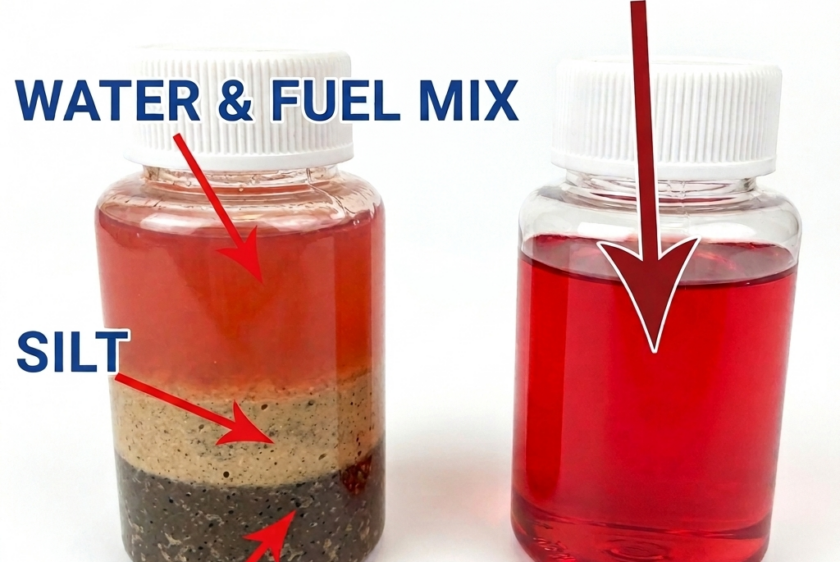
Why Diesel Fuel Contamination Has Gotten Worse, Not Better, Since 2006
Understanding why diesel contamination is a more acute problem today than it was twenty years ago requires understanding two changes that happened to diesel fuel formulation in the mid-2000s that made contamination both more likely and more damaging.
The switch to Ultra-Low Sulfur Diesel (ULSD) reduced natural contamination resistance. The U.S. EPA mandate that reduced highway diesel sulfur content from up to 500 ppm to 15 ppm — completed in 2006 — was an environmental and public health success. It was also a fuel chemistry change with significant downstream consequences for fuel stability and contamination resistance that most users are unaware of.
The hydrotreating process that removes sulfur to ultra-low levels also strips away natural antioxidant compounds that were present in higher-sulfur diesel formulations. These antioxidants had been providing two forms of protection: resistance to oxidative degradation during storage, and a degree of natural antimicrobial activity that inhibited microbial growth at the fuel-water interface. Both forms of protection are substantially reduced in ULSD.
As a practical consequence, ULSD stored in warm, humid environments can begin to oxidize in as little as two months, and many ULSD formulations have an effective storage life under one year — substantially shorter than older high-sulfur diesel stored under similar conditions. This is one reason why diesel stored in backup generator tanks, seasonal equipment, and fleet bulk storage tanks degrades faster today than the same tank with the same fuel management practices did with pre-ULSD fuel.
Modern high-pressure injection systems have dramatically tighter contamination tolerance. The same period that saw the ULSD transition also saw widespread adoption of high-pressure common rail (HPCR) injection technology in diesel engines. Common rail systems operate at injection pressures five to ten times higher than the mechanical injection systems they replaced — in some current-generation systems, fuel is injected at pressures exceeding 30,000 psi (2,000 bar). At these pressures, the clearances between injector needle and body are measured in microns. A single hard particle in that gap at those pressures causes wear rates that would have been inconsequential in an older mechanical injection system.
The result is a convergence: engines that are dramatically more sensitive to contamination, running on fuel with dramatically less natural contamination resistance. This is the operating environment for diesel fuel in 2026, and it’s why contamination prevention and early detection matter more now than they ever did before.
The Four Primary Types of Diesel Fuel Contamination
1. Water Contamination
Water is the most common and, in combination with other contamination types, the most destructive diesel contaminant. It enters fuel through multiple pathways:
- Condensation: As storage tanks cycle through daily and seasonal temperature variations, humid air drawn in through tank vents condenses on cooler metal interior surfaces. Each condensation cycle deposits small amounts of water at the tank bottom. Over months of storage, this accumulates into a significant water layer.
- Leaking seals and fill caps: Improperly sealed fill caps, worn vent seals, and degraded gaskets allow direct water ingress during rain or washing operations.
- Delivery contamination: Water carried in a delivery truck's tank from a previous load or from improperly maintained equipment.
- Dissolved water precipitation: Water that was dissolved throughout the fuel column at elevated temperatures can precipitate as a separate free-water phase as temperatures drop.
Water causes three categories of damage: direct corrosion of tank and fuel system metal surfaces, creation of habitat for microbial growth at the water-fuel interface, and direct damage to injection system components. When water reaches a high-pressure common rail injector operating at tens of thousands of psi, it doesn’t compress like fuel — it flashes to steam, and the resulting explosive pressure spike can physically crack or shatter injector tips. This is not a hypothetical failure mode; it’s a documented failure mechanism with a distinct forensic signature when an injector is inspected.
2. Microbial Contamination
Where water and diesel meet, microorganisms grow. The fuel-water interface at the bottom of a diesel storage tank is an ideal habitat: warm (in most geographic climates, at least seasonally), nutrient-rich (hydrocarbons are food for certain bacteria and fungi), dark, and protected from the physical agitation that would otherwise limit population growth.
Hydrocarbon-degrading bacteria consume the hydrocarbon components of diesel as a carbon energy source, producing acidic metabolic byproducts that lower fuel pH, corrode metal surfaces, and degrade fuel chemistry. Fungi (including species of Hormoconis resinae, the “diesel bug” long recognized in aviation fuel) form visible dark-colored biomass colonies. Sulfate-reducing bacteria colonize the water phase and produce hydrogen sulfide, which accelerates corrosion severely in the presence of water and metal.
The biological products — acids, biomass, sulfide — are often more damaging than the organisms themselves. A filter failure in a contaminated system frequently reveals a dense mat of biological sludge coating the filter element, not individual organisms. By the time visible biomass appears in a fuel system, contamination has typically been developing for weeks or months.
The connection to ULSD matters here specifically: pre-ULSD diesel contained sulfur compounds that provided incidental antimicrobial activity. That protection is substantially reduced in ULSD, which is why microbial contamination rates in diesel storage systems have increased since the fuel transition.
3. Particulate Contamination
Particulate contamination in diesel fuel comes from multiple sources, each leaving a characteristic particle type that laboratory analysis can distinguish:
- Tank corrosion: Iron oxide (rust) particles from corroding tank walls and internal surfaces — reddish-brown, typically irregular shape
- Microbial residue: Biological sludge and biofilm fragments breaking loose from colony sites — dark, amorphous, organic
- Delivery contamination: External dirt, dust, and debris introduced through fill caps or delivery equipment — mineral particles of varied composition
- Oxidation products: Asphaltene and gum particles formed by fuel chemistry breakdown during oxidative degradation — dark, carbonaceous
- Wear debris: Metal particles from fuel pump, injector, or other fuel system component wear — metallic, often with distinct morphology
The practical harm from particulate escalates nonlinearly with particle size relative to injection system tolerances. A particle that passes freely through a fuel filter element and causes no harm in an older mechanical injection system can wedge in the micron-level clearances of a common rail injector and initiate wear that progresses until the injector fails.
Biodiesel blends add complexity to particulate contamination: National Renewable Energy Laboratory research has documented that biodiesel blends (B5 through B20) degrade more rapidly than pure diesel, particularly in warm or humid storage environments, generating higher levels of oxidation-derived particulate during storage. Fleets operating blended fuels at northern latitudes may also encounter wax crystal precipitation during cold weather if the blend’s cold-flow properties weren’t formulated for the local temperature range.
4. Chemical and Cross-Contamination
Chemical contamination encompasses everything from intentional wrong-product introduction (gasoline mixed with diesel, off-road dyed diesel used in on-road equipment) to accidental cross-contamination (cleaning chemicals, DEF, lubricating oil) and degradation chemistry (acidic oxidation products, fuel-destabilizing additive interactions).
DEF contamination deserves specific attention because it’s more common than most operators realize, and its damage mechanism is distinct from other contamination types. DEF (diesel exhaust fluid) is a 32.5% urea-water solution used in selective catalytic reduction (SCR) emissions systems. When introduced into a diesel fuel tank — through misfueling or equipment cross-connection — DEF’s urea crystallizes throughout the fuel system as temperatures cycle, forming hard deposits in injectors, fuel pumps, and delivery lines that cannot be flushed out with normal fuel flow. DEF contamination typically requires complete fuel system disassembly and cleaning to remediate, making it one of the more expensive contamination events to address.
Gasoline contamination of diesel reduces flash point dramatically (a safety hazard), reduces cetane to levels that cause detonation and hard starting, and reduces ULSD’s already-marginal lubricity further, accelerating injector and pump wear. Small quantities of gasoline — even a few percent by volume — can produce measurable flash point reduction detectable by laboratory analysis (ASTM D93) before the contamination concentration becomes severe enough to cause engine problems.
How Diesel Contamination Damages Equipment: The Progression
Diesel contamination damage typically follows a progressive sequence that makes early detection through testing so valuable — each stage is substantially more expensive to remediate than the stage before it.
- Stage 1 — Early contamination (detectable by testing, no symptoms yet) Water levels approaching the 200 ppm dissolved-water threshold; microbial counts in the low-to-moderate range; particulate trending upward. No equipment symptoms. Fuel polishing, water removal, and biocide treatment at this stage are inexpensive and completely effective.
- Stage 2 — Filter restriction (first symptom: increased filter change frequency) Particulate and biological sludge beginning to accumulate on fuel filter elements, causing premature filter loading. Equipment still operates normally but filter change intervals shorten. Injectors not yet damaged. Remediation still relatively simple: fuel polishing, filter changes, biocide treatment.
- Stage 3 — Injection system performance decline Injector deposits, partial needle valve restriction, reduced spray quality. Equipment symptoms: rough idle, increased smoke, reduced fuel economy, hard cold starts, marginally reduced power. Injectors potentially cleanable with aggressive fuel system cleaner or professional cleaning equipment at this stage, though some permanent wear may have occurred.
- Stage 4 — Component failure Injector failure (partial or complete), fuel pump wear, corrosion damage to tank and fuel lines. Equipment symptoms: cylinder misfires, significant power loss, visible smoke, failure to start. Repair at this stage involves component replacement — the most expensive outcome, and the one most commonly attributed in maintenance records to "injector failure" rather than to its actual cause: contaminated fuel.
Warning Signs of Diesel Fuel Contamination
While laboratory testing is the only reliable method for detecting contamination before it causes damage, certain observable signs indicate contamination may already be severe enough to warrant investigation:
Fuel appearance:
- Dark, cloudy, or hazy fuel rather than clean, clear amber
- Visible sediment or sludge, particularly when sampling from the tank bottom
- An oily sheen on the fuel surface indicating biological film
- Distinctive fuel odor changes (sour, sulfurous, or unusual)
Equipment symptoms:
- Increased fuel filter change frequency
- Hard starting, particularly in cold conditions
- Rough idle, hesitation, or misfires
- Visible black or grey exhaust smoke under normal load conditions
- Reduced fuel economy without other apparent cause
- Power loss that doesn't correlate with maintenance history
Storage tank observations:
- Visible rust or discoloration on tank exterior at low points (suggesting internal corrosion)
- Dark residue at drain valves when sumping the tank
- Evidence of water at sample points
Any of these signs warrants immediate laboratory testing rather than waiting for scheduled monitoring intervals. By the time visual signs of contamination appear, the problem has typically progressed to Stage 2 or Stage 3 in the damage progression above.
Laboratory Testing for Diesel Fuel Contamination
Because most diesel fuel contamination causes no visible change in fuel appearance until contamination is advanced, laboratory testing is the only reliable early detection method. The specific tests that matter depend on what contamination type is suspected — see our Diesel Contamination Test page for the full investigative testing panel, or submit your sample with a description of observed symptoms and we’ll recommend the most appropriate scope.
Standard contamination testing panel:
- Water & Sediment — ASTM D2709
- Water by Karl Fischer — ASTM D6304
- Microbial Growth — ASTM D6469
- Particulate Contamination — ASTM D2276
- Flash Point — ASTM D93
- Visual / Clear & Bright — ASTM D4176
Testing is conducted through Sterling Analytical, established 1957, with a 65+ year track record in petroleum fuel analysis. Standard turnaround: 3–5 business days. Rush service available.
Prevention: What Actually Reduces Diesel Contamination Risk
Prevention is substantially cheaper than remediation at every stage of contamination progression. The most effective practices target the root causes rather than the symptoms:
Tank management:
- Maintain tank levels as high as practical to minimize the air space available for condensation cycling
- Inspect and maintain tank vents, fill caps, and seals at regular intervals
- Sump tanks regularly to remove accumulated water before it reaches levels supporting microbial growth
- Consider tank lining programs for older carbon steel tanks prone to internal corrosion
Fuel management:
- Establisl incoming delivery testing to verify fuel quality at receipt
- Maintain quarterly testing schedules for bulk storage rather than relying on annual-only programs
- Use fuel stabilizers for fuel held beyond six months — ULSD's reduced antioxidant content makes this more important than it was for pre-ULSD fuel
- Rotate fuel inventory to prevent extended storage beyond one year
Equipment maintenance:
- Replace fuel filters on schedule rather than extending intervals to reduce cost
- Use approved fuel system cleaning additives proactively for equipment with high-pressure common rail injection systems
- Address fuel system leaks and seal degradation promptly rather than monitoring
Who Needs Diesel Fuel Contamination Testing
- Fleet operators and equipment managers — bulk diesel storage operators, trucking companies, construction equipment fleets, agricultural operations, and any organization using significant volumes of diesel fuel benefit from routine contamination monitoring before equipment symptoms develop.
- Facility managers — organizations with standby diesel generators, fuel storage tanks, or diesel-powered facility equipment need contamination monitoring programs scaled to their storage conditions and operational risk.
- Equipment repair shops — diesel technicians investigating recurring injector failures, fuel system problems, or symptoms that don't respond to standard repair need fuel quality data to determine whether contamination is contributing.
- Insurance and warranty investigators — contamination analysis with chain-of-custody documentation supports claims where fuel quality is a potential contributing factor to equipment damage.
Request Diesel Fuel Contamination Testing
Submit your sample with details about fuel age, storage conditions, and observed symptoms. We’ll recommend the testing panel most appropriate for your situation and provide results with interpretation and remediation guidance.
Testing conducted through Sterling Analytical, West Springfield, Massachusetts, established 1957.
Frequently Asked Questions
The four primary types are water contamination, microbial contamination (bacteria and fungi at the water-fuel interface), particulate contamination (from corrosion, biological residue, and oxidation products), and chemical or cross-contamination from incompatible fluids like gasoline or DEF.
Ultra-Low Sulfur Diesel is more susceptible to contamination because the hydrotreating process that removes sulfur also removes natural antioxidants and antimicrobial compounds. ULSD can begin oxidizing in as little as two months and is more vulnerable to microbial growth than older diesel formulations.
Early signs include dark or cloudy fuel, visible sediment, increased filter change frequency, hard starting, rough idle, and reduced fuel economy. However, most contamination causes no visible change until it's advanced — laboratory testing is the only reliable early detection method.
Yes, and more severely than older injection systems. Common rail injectors operate at tolerances measured in microns under pressures exceeding 30,000 psi. Particulate, water, and biological contamination that older mechanical injection systems tolerated can cause rapid, severe damage to HPCR injectors.
Ultra-Low Sulfur Diesel, the standard highway fuel since 2006, is more susceptible to microbial contamination than predecessor formulations because the deep hydrotreating process that removes sulfur also removes naturally occurring antimicrobial sulfur compounds. This means stored ULSD in warm, humid environments requires more active water management and more frequent microbial monitoring than older diesel formulations did.
DEF contamination is serious — the urea crystallizes throughout the fuel system as temperatures cycle, forming hard deposits in injectors, pumps, and delivery lines that typically cannot be flushed out with fuel flow alone, requiring complete fuel system disassembly and cleaning to remediate.
Key prevention practices include maintaining high tank levels to minimize condensation, regular inspection of seals and vents, quarterly bulk storage testing rather than annual-only programs, incoming delivery verification, fuel stabilizer use for fuel held beyond six months, and proper fuel inventory rotation.
Sometimes, but unreliably. Visible water layers, dark color, visible sludge, and unusual odor are warning signs. However, dissolved water, early-stage microbial contamination, particulate below visual threshold, and cross-contamination with small volumes of gasoline may all be present at damaging levels without producing any visible changes in the fuel.
Biodiesel in blends (including B5 found in most commercial diesel today) is both more hygroscopic than petroleum diesel and more nutritionally attractive to fuel microbes. This means biodiesel blends accumulate water faster and support faster microbial growth under equivalent storage conditions than pure petroleum diesel.
Quick Contact
If you have any questions or need help, feel free to contact with our team.
Send Us Email:
Call Us Today: