Phone:
(413) 214-6541
Location:
15 Agawam Ave West Springfield, MA 01089
Mon - Fri:
8.00am - 7.00pm
Parent Website:
sterlinganalytical.com

Diesel Fuel Contamination for Long Term Storage
Diesel fuel stored for extended periods faces a contamination and degradation risk profile fundamentally different from fuel that turns over actively. The diesel in an active fleet fueling depot that’s replenished weekly behaves very differently from the diesel in a hospital backup generator tank that was filled eighteen months ago and hasn’t been touched since. Long-term storage creates conditions — extended air contact, cumulative condensation, stagnant fuel with no thermal agitation, biological colonization time — that active-use fuel simply doesn’t experience.
Diesel Fuel Lab provides long-term storage contamination testing through Sterling Analytical, specifically designed to catch the degradation and contamination patterns that develop in stored fuel before they result in equipment failure when the fuel is finally needed. This is the testing program that answers the question every facility manager should be asking about their stored generator fuel: not “does this fuel look okay?” but “will this fuel actually perform when I need it, and what’s happening to it right now that I can’t see?”
The Storage Stability Problem That Most Fuel Users Don't Know They Have
Here’s a fact that surprises most diesel users when they first encounter it: the diesel fuel you’re storing today is chemically less stable in storage than the diesel your predecessors were managing twenty years ago — and the gap is significant, not marginal.
Two changes in diesel fuel chemistry have converged to make long-term storage substantially more challenging than it was for previous generations of facility managers:
- Change 1: Ultra-Low Sulfur Diesel removed natural preservative compounds. The hydrotreating process that reduced diesel sulfur from up to 500 ppm to 15 ppm didn't just remove sulfur — it stripped out naturally occurring antioxidants and antimicrobial sulfur compounds that had been providing passive protection to stored fuel. Pre-ULSD diesel benefited from these compounds without anyone consciously managing them. ULSD does not. The practical result: untreated ULSD in typical storage conditions can begin degrading in as little as 6–12 months; with proper additive treatment and good storage conditions, 18–24 months is achievable but requires active management, not passive assumption.
- Change 2: Modern refinery processes produce more reactive fuel molecules. Today's refineries use advanced conversion processes — hydrocracking and catalytic cracking — to extract more usable fuel yield from each barrel of crude oil than older distillation-only processes could achieve. These processes break larger, more stable hydrocarbon molecules into smaller, more reactive ones. The fuel yield per barrel improves; the inherent stability of the resulting fuel in storage does not.
The practical consequence of both changes together: fuel sitting in a backup generator tank that was considered adequately managed under practices developed for pre-ULSD diesel is now genuinely at risk under those same practices. Annual testing that was conservative management before ULSD is now the minimum floor, not a comfortable margin.
The Hidden Biodiesel Problem: The Contamination Risk You're Already Managing Without Knowing
Almost all commercial diesel fuel sold in the United States today contains biodiesel — typically up to 5% (B5) and sometimes higher in certain regions. Biodiesel blending is not required to be disclosed on retail fuel labels at concentrations at or below B5, meaning most fuel buyers are storing a biodiesel blend without knowing it.
This matters specifically for long-term storage because biodiesel has two properties that make it meaningfully worse for storage than petroleum diesel:
- Biodiesel is hygroscopic. Biodiesel molecules attract and absorb water from the surrounding environment more readily than petroleum hydrocarbon molecules do. This means a B5 blend stored in a tank will accumulate water faster than pure petroleum diesel stored under identical conditions — not dramatically faster for a 5% blend, but meaningfully faster over months of storage through temperature-cycling condensation.
- Biodiesel is more nutritionally attractive to fuel microbes. The ester bonds in biodiesel molecules are more accessible energy sources for hydrocarbon-degrading bacteria and fungi than the more stable petroleum hydrocarbons in base diesel. This means microbial populations at the fuel-water interface grow faster and reach damaging levels sooner in biodiesel blends than in pure petroleum diesel under equivalent water availability.
The combination of increased water affinity and increased microbial nutrition creates a compounding contamination risk in the typical long-term storage scenario. Stored B5 diesel is not dramatically less stable than pure petroleum diesel — but it’s meaningfully less stable, and that margin matters when fuel has been sitting in a tank for 12, 18, or 24 months.
How Diesel Degrades in Storage: A Timeline
Long-term diesel storage degradation follows a characteristic sequence. Understanding this timeline helps frame testing intervals and remediation decisions.
Stage 1: Oxidative instability onset (0–6 months)
Fresh diesel appears clear and light amber. Within the first months of storage, oxygen dissolved in the fuel and present in the tank air space begins reacting with fuel hydrocarbons. Oxidation is initially invisible — no color change, no visible particles, no equipment symptoms. The ASTM D2274 oxidation stability test detects developing instability at this stage by predicting how rapidly gums and sediment will form under accelerated conditions. A fuel showing elevated D2274 insolubles at the 6-month mark is telling you it will cause filter problems at the 12-month mark — useful information when you still have time to treat with stabilizer rather than replace fuel.
A key physical relationship worth knowing: the oxidation rate approximately doubles for every 10°C (18°F) increase in fuel temperature. Fuel stored at 40°C (104°F) — a realistic summer temperature inside a sun-exposed aboveground tank — degrades roughly four times faster than the same fuel stored at 20°C (68°F). Tank location, insulation, and shade matter enormously for how quickly this timeline progresses.
Stage 2: Color change and visible degradation (6–18 months)
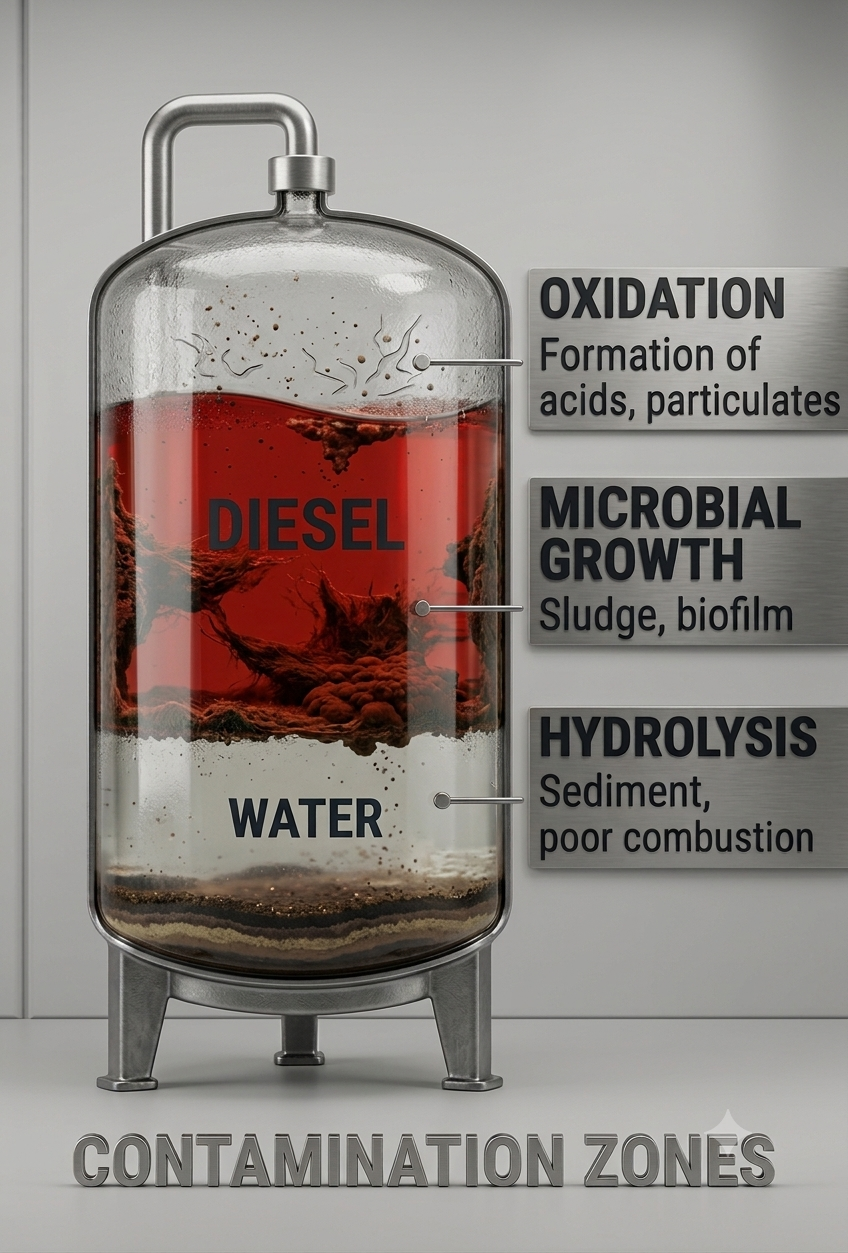
Oxidation products — gums, varnishes, and early asphaltene precipitates — begin to affect fuel appearance. Diesel that was clear amber darkens toward brown or amber-brown. This color change is the first visible sign that degradation is underway, but by the time it’s visible, oxidation has typically been progressing for months. Asphaltenes — the heaviest molecular fraction of diesel — become unstable and begin to precipitate out of solution as oxidation proceeds, eventually forming the dark, sticky sludge found at the bottom of long-term storage tanks.
Simultaneously, if water has been accumulating through condensation (as it does in virtually every vented aboveground tank over 6–18 months), microbial colonization begins at the fuel-water interface. Early microbial growth is invisible without testing; only ASTM D6469 screening or ATP bioluminescence (ASTM D7463) reveals what’s growing at this stage.
Stage 3: Filter restriction and active biological phase (18+ months)
Oxidation products and microbial biomass reach concentrations that cause observable equipment effects. Fuel filters begin restricting faster than normal. Dark, sticky material appears in fuel samples from the tank bottom. Microbial sludge — visible as dark, gelatinous material — coats the tank bottom and walls at and below the fuel-water interface. At this stage, fuel polishing alone is typically insufficient; biocide treatment is required before polishing, and depending on severity, tank cleaning may be necessary before new fuel is introduced.
Why ASTM D975 Doesn't Protect You in Long-Term Storage
This point is important enough to restate in the specific context of long-term storage: ASTM D975, the Standard Specification for Diesel Fuel Oils, defines fuel quality at the time and place of delivery from the supplier. It is not a storage quality standard.
Your fuel supplier’s Certificate of Analysis documenting D975 compliance at delivery tells you the fuel met specification when it left the terminal. It tells you nothing about what that fuel looks like after 12 months in your generator tank through four seasons of temperature cycling, condensation, and air exposure. NFPA 110’s mandate for annual fuel testing using appropriate ASTM standards exists precisely because delivery-stage compliance is not equivalent to storage-condition fitness.
The specific ASTM tests that matter for long-term storage are not the same as the full D975 specification battery:
Storage-Relevant Test | ASTM Method | What It Reveals |
Oxidation Stability | D2274 | Remaining storage life; predicts gum and sediment formation rate |
Water by Karl Fischer | D6304 | Dissolved water at ppm level; early detection before microbial threshold |
Water & Sediment | D2709 | Free water and settled solids at storage tank bottom |
Microbial Contamination | D6469 | Biological colonization at fuel-water interface |
Particulate Contamination | D2276 | Oxidation and microbial byproduct accumulation |
Acid Number | D664 | Acidic degradation product buildup from oxidation and microbial activity |
Visual / Clear & Bright | D4176 | Baseline appearance documentation and color change detection |
The oxidation stability test (ASTM D2274) and the acid number test (ASTM D664) are particularly valuable for long-term storage monitoring because they measure the cumulative effects of time-driven degradation rather than just point-in-time contamination — they tell you not just whether something has happened, but how far degradation has progressed.
The "Treat Before Testing" Mistake: Why Sequence Matters
A common error in long-term storage management is adding fuel stabilizer or biocide treatment to stored fuel without first testing to understand current fuel condition. This approach has a significant limitation: additives treat and maintain fuel that is still in acceptable condition; they cannot meaningfully reverse degradation that has already advanced to the point of filter-plugging gum and asphaltene formation, and they cannot eliminate established microbial colonies without adequate biocide.
Adding stabilizer to heavily degraded fuel that’s already producing gum and sediment is the storage equivalent, as one fuel chemistry expert put it, of putting fresh paint on a rotting wall — it provides a surface appearance of treatment without addressing the underlying problem. The correct sequence is:
- Test first — establish current fuel condition before any treatment decision
- Treat appropriately — match treatment to what testing reveals (stabilizer for oxidation risk, biocide for confirmed microbial contamination, polishing for elevated particulate)
- Re-test after treatment — confirm that treatment was effective before relying on the fuel
This sequence is particularly important because the wrong treatment can make situations worse. Pouring a demulsifier into fuel with established microbial contamination may temporarily clarify the fuel’s appearance while leaving the biological source untreated — producing false visual reassurance without eliminating the contamination causing it.
Designing a Long-Term Storage Testing Program
For facilities storing diesel in backup generators, seasonal equipment, bulk reserve tanks, or disaster preparedness reserves, a structured testing program prevents the undetected degradation that causes equipment failures when stored fuel is finally needed.
Recommended testing intervals by storage situation:
Storage Situation | Testing Interval | Rationale |
Generator fuel, facility at risk (hospital, data center) | Every 6 months | NFPA 110 annual minimum; semi-annual for critical-risk applications |
Generator fuel, standard commercial facility | Annually | NFPA 110 minimum requirement |
Bulk seasonal storage (agricultural, construction) | At end of season before storage; at start of season before use | Verify condition before extended storage and before first-of-season use |
Disaster preparedness fuel reserve | Every 6 months | Long-term storage with no predictable use window |
Fleet bulk tank with slow turnover (refill intervals >90 days) | Quarterly | Microbial growth in warm season can outrun annual testing |
Any tank after visible color change or equipment symptoms | Immediately | Visible changes indicate Stage 2 degradation or later |
Minimum test panel for long-term stored fuel:
- Clear & Bright visual (ASTM D4176)
- Water & Sediment (ASTM D2709)
- Water by Karl Fischer (ASTM D6304)
- Particulate Contamination (ASTM D2276)
- Oxidation Stability (ASTM D2274)
Extended panel for fuel held beyond 12 months or with suspected degradation:
- All minimum panel tests, plus:
- Acid Number (D664) — measures accumulated acidic degradation products
- Flash Point (D93) — rules out cross-contamination
- Cetane Index (D4737) — verifies ignition quality hasn't degraded
Remediation: What Options Exist for Compromised Stored Fuel
When testing identifies contamination in long-term stored fuel, remediation options exist for most contamination types at most severity levels — though options narrow as degradation advances:
- Fuel polishing (filtration and water removal) Mechanical filtration removes accumulated particulate and free water without chemical treatment. Appropriate for elevated particulate and water with no or low-level microbial contamination. Does not address dissolved water, oxidation chemistry, or established microbial colonies.
- Biocide treatment EPA-registered biocide products kill active microbial populations at both the fuel phase and water phase. Must be combined with water removal and fuel polishing to eliminate the biomass and conditions that supported microbial growth — biocide alone kills the organisms but doesn't remove their residue. Biocide is most effective when applied early; severe contamination (above 10⁴ CFU/mL) may require aggressive treatment or fuel replacement.
- Fuel stabilizer addition Stabilizers containing antioxidants compensate for ULSD's depleted natural antioxidant content, slowing further oxidative degradation. Effective when added to fuel that is still in acceptable chemical condition; much less effective for fuel that has already undergone significant oxidation. Treating fuel prophylactically — at or before delivery, or at least within the first six months of storage — is far more effective than treating already-degraded fuel.
- Fuel replacement For severely degraded fuel — Stage 3 contamination with entrenched biological growth, heavily oxidized chemistry, high acid number, or dark asphaltene sludge — the cost-effective decision is often fuel replacement and tank cleaning rather than attempting to remediate fuel that has degraded beyond the point where treatment can restore usable quality.
Who Uses Long-Term Storage Contamination Testing
- Critical facility managers (hospitals, data centers, senior care, telecommunications) responsible for backup generator fuel that must perform during emergencies, often without advance notice or opportunity for corrective action at the time of need.
- Emergency management and municipal infrastructure maintaining fuel reserves for disaster response, where fuel may sit for extended periods between refills and must be ready when called upon.
- Agricultural operators managing large seasonal bulk diesel storage between planting and harvest seasons, where fuel may sit for six or more months in tank conditions that favor rapid contamination in warm climates.
- Construction equipment operators with off-season storage, where equipment tanks and bulk storage at remote sites experience extended storage between active use seasons.
- Military and government reserve fuel programs requiring documented quality assurance for strategic fuel reserves held for extended periods under defined storage conditions.
How to Submit a Long-Term Storage Sample
- Contact us with details about your storage situation — tank type (above or below ground), fuel age, last refill date, climate/location, and any previous testing history
- Receive your sample kit — clean containers and sampling instructions specific to storage tank applications
- Collect samples properly:
- Primary sample: from the tank bottom drain, lowest accessible point (where water, sediment, and biological material accumulate)
- Secondary sample: from mid-tank level (bulk fuel condition representative of what would actually be drawn to equipment)
- Note tank level, ambient temperature at time of sampling, and any visible observations
- Ship samples using the prepaid return label
- Receive your Certificate of Analysis with results, degradation stage assessment, and specific remediation guidance
Testing conducted through Sterling Analytical, established 1957, West Springfield, Massachusetts. Visit sterlinganalytical.com →
Request a Quote
Verify Long-Term Diesel Fuel Quality with ASTM-Certified Laboratory Testing
Whether you’re managing backup generator fuel, seasonal equipment storage, emergency fuel reserves, or bulk diesel tanks, our testing services help identify contamination, oxidation, microbial growth, and storage-related degradation before they cause equipment failures.
Frequently Asked Questions
Untreated ULSD typically maintains acceptable quality for 6–12 months under average storage conditions. With proper additive treatment (stabilizer, biocide) and good storage practices (cool, sealed, minimal air space), 18–24 months is achievable. Biodiesel blends (B5 and higher) have shorter effective storage lives than pure petroleum diesel under equivalent conditions.
Yes, meaningfully so. The hydrotreating process that produces ULSD removes natural antioxidant and antimicrobial compounds that helped protect older high-sulfur diesel during storage. ULSD also contains biodiesel blends in most markets, which are hygroscopic and more susceptible to microbial contamination.
Oxidation rate approximately doubles for every 10°C (18°F) temperature increase. Fuel stored in a sun-exposed above-ground tank at summer temperatures degrades four times faster than fuel at moderate ambient temperatures. Tank location, shade, and insulation all affect how quickly the degradation timeline progresses.
ASTM D2274 accelerates fuel aging under controlled conditions to predict how rapidly gums and sediment will form. A fuel showing elevated insolubles at 6 months is signaling future filter problems before they occur — while treatment is still simple and effective.
Test first, then treat. Adding stabilizer to already-degraded fuel doesn't reverse existing oxidation damage and can create false confidence about fuel condition. Testing first establishes whether stabilizer treatment is sufficient, or whether more aggressive remediation (polishing, biocide, or replacement) is needed.
It depends on the test results. Fuel with elevated water and particulate but no significant oxidation or biological contamination can often be polished and returned to acceptable condition. Fuel with advanced oxidation chemistry, high acid number, or severe microbial contamination is more difficult and sometimes uneconomical to remediate — replacement may be more cost-effective.
Quick Contact
If you have any questions or need help, feel free to contact with our team.
Send Us Email:
Call Us Today: