Phone:
(413) 214-6541
Location:
15 Agawam Ave West Springfield, MA 01089
Mon - Fri:
8.00am - 7.00pm
Parent Website:
sterlinganalytical.com
Aviation Fuel Contamination Test
Related Posts
Diesel Fuel Lab provides aviation fuel contamination testing — laboratory analysis identifying water, surfactant, microbial, and particulate contamination in Jet-A, Jet-A1, and other aviation turbine fuels. Our testing is conducted through Sterling Analytical (sterlinganalytical.com), providing ASTM-certified analysis for FBOs, airport fuel handling operations, corporate flight departments, fuel distributors, and investigators following aviation fuel-related incidents.
Aviation fuel contamination testing occupies a specific position in aviation fuel quality assurance that’s distinct from routine specification testing. Where specification testing (ASTM D1655 panel) asks “does this fuel meet its full property specification?”, contamination testing asks a more targeted question: “what specific contaminants are present, how did they get here, and what do I need to do about it?” These are the questions that arise at an FBO when a filter gives an unexpected Millipore result, when a corporate flight department discovers an anomaly during preflight, or when an aircraft reports a fuel-system-related squawk that traces back to fuel handling infrastructure.
Understanding aviation fuel contamination requires distinguishing between four contamination types that behave very differently and require different laboratory tests to detect, different remediation approaches to address, and — critically — leave different evidence trails for root cause investigation.
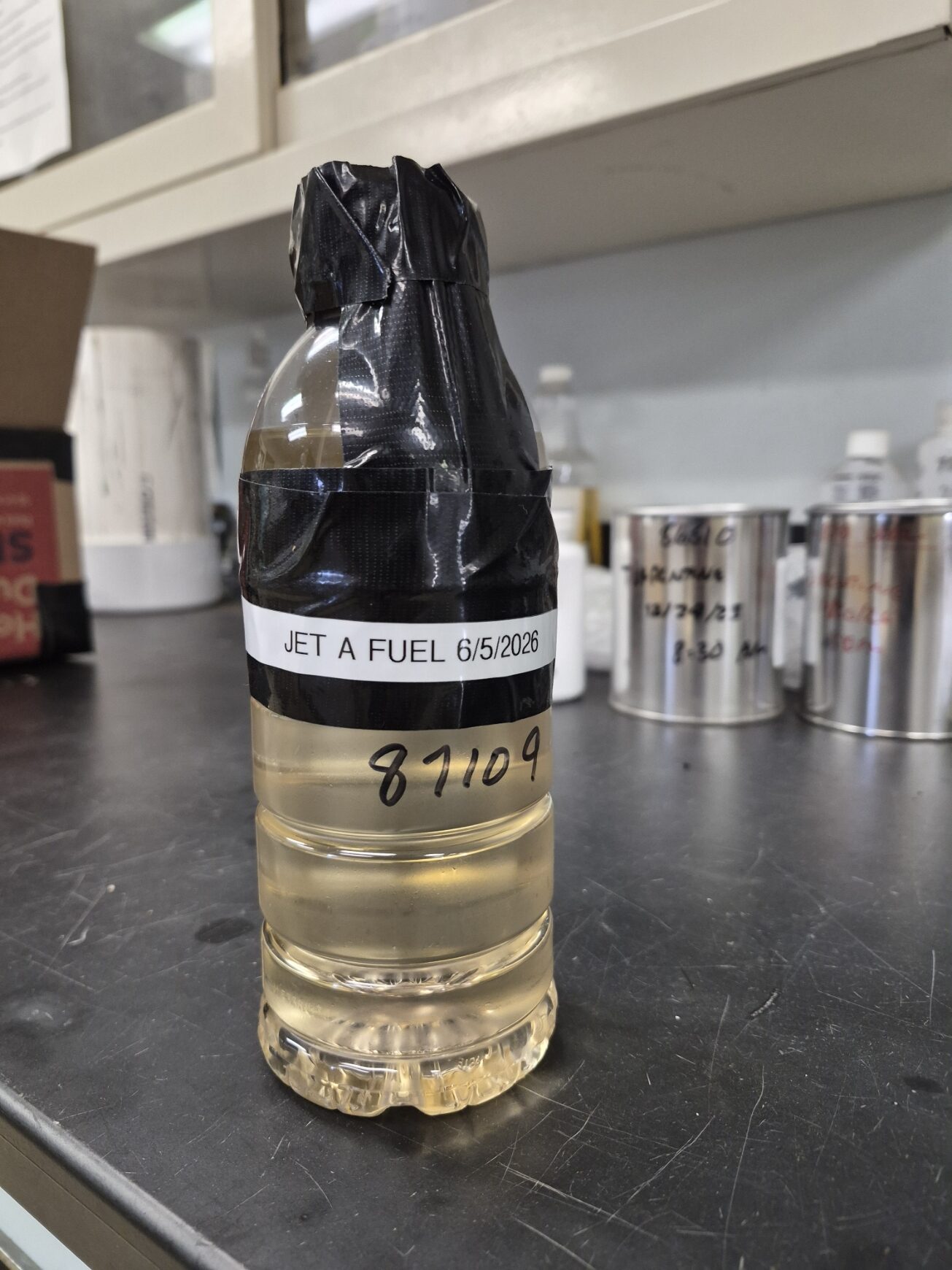
The Four Aviation Fuel Contamination Types: Why Each Requires a Different Response
Water Contamination
Water is the most prevalent contaminant in aviation fuel systems and is present in two forms that matter differently:
Free water — visible water droplets or a separate water phase — settles to the lowest point in fuel storage and handling equipment and is detectable by visual sump checking and ASTM D2709 centrifuge testing. Free water at the tank bottom is also detectable by ASTM D6304 Karl Fischer titration, the more sensitive method that quantifies both dissolved and free water in a single test.
Dissolved water — water dispersed throughout the fuel at the molecular level, below the concentration needed to form a visible separate phase — is detectable only by Karl Fischer (ASTM D6304). Dissolved water in aviation fuel at elevated concentrations creates two risks that free water alone doesn’t capture: first, it can crystallize at high-altitude temperatures even when no visible water phase was present at ground level, and second, elevated dissolved water content creates the conditions for microbial growth at the fuel-water interface even when no visible water layer is present at the tank bottom.
The one-hour water settling time — a documented characteristic of aviation turbine fuel that means a pre-departure sump check can miss water that was introduced recently and hasn’t had time to settle — makes dissolved water testing particularly important as a complement to visual sump inspection. Laboratory Karl Fischer testing catches what the sump check can miss.
Surfactant Contamination
Surfactant contamination is the most operationally dangerous aviation fuel contamination type that most people haven’t heard of — and it’s dangerous specifically because it looks like nothing. Fuel with surfactant contamination appears visually clean, passes visual inspection, and may even pass some field checks. What it fails is the filter/separator function that aviation fuel handling systems rely on to keep water out of aircraft.
Aviation fuel is processed through filter/separator vessels specifically designed to coalesce (gather together) finely dispersed water droplets and separate them from the fuel before it reaches an aircraft. This coalescing function depends on water droplets contacting filter coalescer elements and merging into larger droplets that then separate under gravity. Surfactants — surface-active compounds that reduce the interfacial tension between water and fuel — prevent this coalescence. Surfactant-contaminated fuel reaches a filter/separator vessel where water droplets simply fail to coalesce and instead pass through the filter/separator into the aircraft fuel system in a finely dispersed form that the separator was designed to prevent.
The fuel leaving a filter/separator contaminated by surfactants passes all visual checks and may even pass a standard Millipore particulate test. What it fails is the WSIM water separation test (ASTM D3948), which specifically measures a fuel’s tendency to release dispersed water — the test that detects the functional failure that surfactant contamination causes.
Surfactants enter aviation fuel from multiple sources: cleaning agents used to clean tanks, fuel trucks, or hydrant equipment that weren’t fully rinsed; biosurfactants produced by microbial colonies at the fuel-water interface; pipeline inhibitor additives injected upstream; and residue from previously contaminated equipment batches. The SKYbrary aviation safety database notes that once surfactant contamination is present, the remediation path requires clay treatment — passing the fuel through attapulgite clay beds that adsorb surfactants from the fuel — after conventional filtration and water removal have addressed the particulate and water components.
Microbial Contamination
IATA considers microbial contamination in jet fuel significant enough to have published a dedicated 60-page guidance document specifically addressing it — a reasonable indicator of how seriously the aviation fuel handling industry takes this contamination type.
Bacteria and fungi colonize the water-fuel interface in aviation fuel tanks and handling equipment wherever water accumulates. The operational consequences are real and potentially dangerous: microbial biomass clogs fuel filters (a filter blockage warning in the cockpit, especially at the high fuel demands of takeoff power, indicates a fuel system restriction that demands immediate attention); acidic metabolic byproducts corrode steel and aluminum surfaces in fuel system components; and biosurfactant production from microbial colonies creates the secondary surfactant contamination problem described above, turning a biological problem into a water separation problem simultaneously.
ASTM D6469 provides the standard guide for microbial contamination in fuel systems. ATP bioluminescence testing (ASTM D7463) offers a faster supplementary screening method — measuring adenosine triphosphate as a proxy for living cell activity — that can indicate whether significant microbial populations are present before the slower culture-based count methods return results. For aviation applications where fuel system problems require rapid diagnosis, ATP testing is particularly valuable.
Particulate Contamination
Particulate contamination in aviation fuel comes from tank corrosion and coating degradation (FAA Advisory Circular 150/5230-4B specifically cites tank corrosion as an ongoing and often underappreciated source of particulate in airport fuel handling systems), from microbial biomass breaking free from colony sites, from delivery and handling equipment, and from degradation of filter elements approaching end of service life.
The Millipore test (ASTM D2276) — covered in detail on our Millipore Test Aviation Fuel page — is the primary field tool for particulate detection in aviation fuel handling. Laboratory gravimetric analysis provides the quantitative confirmation and chain-of-custody documentation needed for investigation purposes. Under ATA Specification 103, fuel is unacceptable if gravimetric particulate analysis exceeds 2.0 mg/gallon or 0.5 mg/L.
When Aviation Fuel Contamination Testing Is Required
Aviation fuel contamination testing is triggered by specific operational events and findings, not only by scheduled monitoring intervals:
- Anomalous Millipore result When a field Millipore colorimetric test returns a result at or beyond the first-page limit of the color rating booklet, ATA-103 protocols require confirmatory testing — including gravimetric analysis if the primary and check membranes differ by three or more color rating positions. Laboratory gravimetric testing with chain-of-custody documentation provides the required confirmation.
- Low WSIM water separation result A water separation index below 85 (the ATA-103 minimum for Jet-A in most applications) indicates surfactant contamination that is functionally disabling the filter/separator system. Source investigation — tracking back through the handling chain from the failing test point — requires samples from multiple points in the system for comparative analysis.
- Pre-flight fuel system anomaly When an aircraft crew or maintenance technician reports a fuel-related squawk — unusual cockpit fuel indications, fuel filter differential pressure warning, unexpected fuel system behavior during ground check — laboratory analysis of fuel from the aircraft's tanks, fuel truck, and storage system provides the analytical data to determine whether fuel quality was a contributing factor.
- Post-fueling incident investigation Any time a fueling event is suspected of introducing contamination — a misfueling concern, a contaminated delivery, a filter found with visible particles or biological material — laboratory testing of retained fuel samples from the aircraft, the fueling truck, and the storage system provides the chain-of-evidence documentation for the investigation.
- Routine quality assurance programs Corporate flight departments, charter operators, and FBOs with on-site fuel farms include periodic contamination testing — distinct from the specification testing conducted at delivery receipt — as part of ongoing quality assurance programs. Testing frequency depends on fuel volume and turnover; quarterly testing is common for corporate flight department fuel farms with moderate turnover.
The Aviation Fuel Contamination Testing Panel
Laboratory aviation fuel contamination testing combines multiple complementary tests because no single test detects all contamination types:
Test | ASTM Method | Contamination Type Detected |
Water Separation Index (WSIM) | D3948 | Surfactant contamination — the test specifically designed for this |
Water by Karl Fischer | D6304 | Dissolved water at ppm level; dissolved and free water quantification |
Water & Sediment | D2709 | Free water and settled solids by centrifuge |
Microbial Contamination | D6469 | Bacteria and fungi at fuel-water interface |
ATP Bioluminescence | D7463 | Rapid microbial activity screening |
Particulate (Gravimetric) | D2276, D5452 | Quantitative insoluble solids in mg/L |
Flash Point | D93 | Cross-contamination with avgas or volatile hydrocarbons |
Visual / Clear & Bright | D4176 | Appearance and color baseline |
Electrical Conductivity | D2624 | Static dissipater additive level verification |
Panel scope is adjusted based on the specific contamination concern. An investigation triggered by a low WSIM result centers on the D3948 test and water analysis. A post-fueling investigation following a filter anomaly centers on particulate and water. A microbial contamination investigation emphasizes D6469 and ATP with acid number to assess corrosion byproduct accumulation.
Contamination Source Investigation: Following the Evidence Chain
Aviation fuel contamination investigation follows the fuel from aircraft backward through the handling chain to identify where the contamination originated. The evidence chain typically runs: aircraft fuel tanks → fueling truck or hydrant cart → hydrant pit → airport storage tank → receiving pipeline or tanker delivery.
Collecting samples from multiple points in this chain simultaneously — before any remediation is undertaken — is essential for investigation. A surfactant contamination problem that appears in the aircraft fuel (low WSIM on an aircraft tank sample) may originate in the fueling truck (contaminated truck tank or truck-mounted filter/separator), in the hydrant system (improperly cleaned hydrant equipment following maintenance), or in the airport storage tank (biosurfactants from established microbial contamination in the tank). Each source has different remediation implications and different accountability consequences.
Comparative analysis of samples from multiple chain points — aircraft, truck, hydrant, tank — allows the investigation to identify exactly where in the chain the WSIM score drops from acceptable to failing, which defines both the contamination origin and the scope of remediation needed.
This is the critical difference between a contamination test for compliance verification (testing one sample against a specification) and a contamination investigation (testing multiple samples across a system to identify source and scope). Both require laboratory analysis; the investigation requires a structured multi-point sampling plan executed before remediation begins.
ATA Specification 103 and IATA Requirements for Contamination Testing
ATA Specification 103 (Standard for Jet Fuel Quality Control at Airports) mandates specific contamination testing checkpoints in the airport fuel handling process:
- Underwing nozzle screen inspection — required before each fueling; screens examined for particles or solid contaminants with findings documented and retained for 12 months
- Millipore test — required at defined intervals and when nozzle screen inspection reveals particles
- WSIM water separation testing — required periodically and when surfactant contamination is suspected
- Bottom sumping and visual inspection — required at defined intervals for fuel storage and vehicle tanks
IATA guidance provides complementary requirements for airline fuel quality programs, including specific microbial contamination monitoring guidance that addresses both the testing methods and the response actions for various contamination levels. The 60-page IATA guidance document on microbial contamination reflects the sustained attention this contamination type receives in commercial aviation fuel management — it’s not a niche concern treated in a paragraph but a systematic operational risk that commercial carriers manage through documented programs.
Chain-of-Custody Documentation for Aviation Contamination Investigations
Aviation fuel contamination investigations with potential safety, regulatory, or legal implications require chain-of-custody controlled sample handling and laboratory documentation. This is particularly important in situations involving:
- Aircraft incidents or accidents where fuel quality is under investigation by FAA or NTSB
- Misfueling events where insurance or liability issues may arise
- Commercial disputes between fuel suppliers and operators regarding fuel quality at delivery
- Regulatory compliance investigations involving airport fuel handling certification
Our laboratory through Sterling Analytical provides chain-of-custody sample intake, secure sample storage, complete analytical records, and certificate documentation suitable for evidentiary purposes. We recommend contacting us before sample collection when chain-of-custody documentation may be needed, so we can provide appropriate sample containers and collection documentation from the start of the process.
Who Uses Aviation Fuel Contamination Testing
- FBOs and airport fuel handling operations investigating anomalous field test results, customer complaints, or equipment findings that may indicate fuel quality problems.
- Corporate flight departments and charter operators maintaining documented quality assurance programs for on-site fuel farms, including periodic contamination testing beyond routine specification verification.
- Airport authorities and fuel farm operators investigating contamination events that may have affected multiple customers loading from the same fuel supply.
- Aviation maintenance organizations supporting airworthiness investigations where fuel quality is a potential contributing factor to a maintenance finding or aircraft system anomaly.
- Aviation insurance adjusters and attorneys requiring laboratory documentation for claims investigations involving fuel-related aircraft incidents.
- Fuel distributors and terminal operators investigating customer contamination complaints and determining whether contamination originated upstream of the terminal or in customer-owned equipment.
How to Submit Aviation Fuel Contamination Samples
- Contact us before collection if chain-of-custody documentation may be needed — we provide appropriate containers and documentation from the start
- Describe the investigation context — what anomaly or event triggered testing, which points in the fuel handling chain are included, and what specific contamination type is suspected
- Collect samples from all relevant chain points simultaneously — aircraft tank, fueling truck, hydrant, storage tank — before any remediation is undertaken
- Label each sample completely — source point, date and time, fuel type, chain position (aircraft/truck/hydrant/storage), and any relevant observations at time of collection
- Ship samples using provided containers and packaging
- Receive your Certificate of Analysis — with results for each sample, specification comparisons, and comparative interpretation across the sample set for multi-point investigations
Standard turnaround: 3–5 business days. Rush 24–48 hour service available for active incident investigations.
Testing conducted through Sterling Analytical, established 1957, West Springfield, Massachusetts. Visit sterlinganalytical.com →
Request a Quote
Water contamination, surfactants, microbial growth, and particulate contamination can affect fuel quality long before problems become visible during routine inspections. Whether you’re investigating a failed Millipore test, low WSIM result, suspected microbial contamination, fuel system anomaly, or post-fueling incident, our laboratory team can recommend the appropriate ASTM testing panel and sampling strategy for your situation.
Frequently Asked Questions
Specification testing (ASTM D1655 panel) verifies that fuel meets its full property specification. Contamination testing focuses on identifying specific contaminants — water, surfactants, microbes, or particulate — their concentration, and likely source. Contamination testing is typically triggered by a specific event or finding and is designed for root cause investigation, not routine batch certification.
Surfactants are surface-active compounds that reduce water-fuel interfacial tension. In aviation fuel, they prevent the filter/separator system from coalescing and separating dispersed water — so water that the filter/separator is designed to remove instead passes through into the aircraft fuel system. Surfactant-contaminated fuel looks clean and may pass visual inspection while the water separation equipment protecting the aircraft is functionally disabled. The WSIM test (ASTM D3948) is specifically designed to detect this.
Potentially yes. Dissolved water, surfactant contamination, early-stage microbial growth, and particulate at concentrations below visual detection can all be present at levels that affect fuel system performance or equipment life while producing no visible change in fuel appearance. Laboratory testing detects what visual inspection cannot.
IATA published a 60-page dedicated guidance document on microbial contamination in jet fuel as part of its 5th Edition guidance materials. The document addresses risk identification, monitoring approaches, testing methods, and response actions — evidence of how systematically microbial contamination is managed in commercial aviation fuel programs.
Sometimes. Particulate contamination is addressed by filtration. Free water is addressed by sumping and water removal. Microbial contamination requires biocide treatment plus filtration to remove biomass. Surfactant contamination requires clay treatment — attapulgite clay beds that adsorb surfactants from the fuel. Severely contaminated fuel may need to be removed from the fuel system entirely and replaced with verified clean product before operations resume.
As many as are relevant to identifying the source. A minimum investigation should include the terminal storage tank, the fueling truck or hydrant cart, and the aircraft tank. Additional points — hydrant pit, receiving pipeline interface, fueling nozzle — add granularity that narrows the source identification. The investigation resolution is limited by the number of chain points sampled; more points provide better source identification.
Quick Contact
If you have any questions or need help, feel free to contact with our team.
Send Us Email:
Call Us Today: